

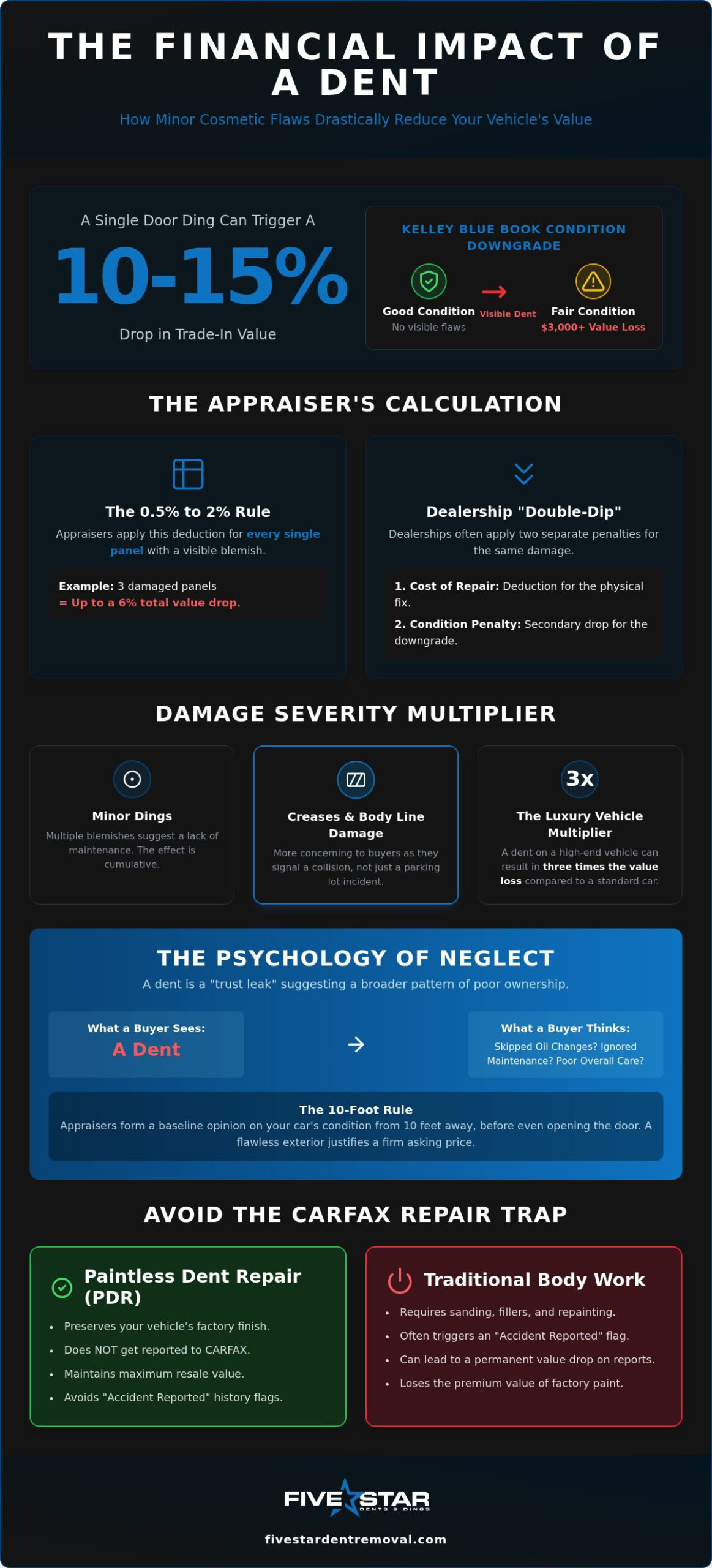
Did you know that a single door ding can trigger a 10% to 15% drop in your car’s trade-in value? Kelley Blue Book guidelines for 2026 state that visible dents automatically downgrade a vehicle from “Good” to “Fair” condition. If you are preparing to sell, you need to know exactly how much does a dent devalue a car before stepping onto a dealership lot. A small cosmetic flaw can lead to a loss of thousands of dollars on your final offer.
It’s frustrating when a stray shopping cart or a parking lot mishap threatens your investment. You’ve worked hard to keep your vehicle in top shape, and you shouldn’t have to settle for a low-ball offer or face anxiety over lease return penalties. We understand that drivers in Alpharetta and North Atlanta want a reliable way to maintain their vehicle’s history and aesthetic appeal without unnecessary complications.
This guide breaks down the financial impact of vehicle damage and explains how professional Paintless Dent Repair (PDR) techniques protect your resale value. You’ll discover how to avoid “neglect” flags from buyers and why preserving your factory paint is essential for a clean history report. We provide the clarity you need to maximize your trade-in price and ensure your vehicle looks its absolute best.
Key Takeaways
- Learn how dealerships use the 0.5% to 2% rule to significantly reduce trade-in offers for minor panel blemishes.
- Understand exactly how much does a dent devalue a car by identifying the “Neglect Factor” that causes buyers to question your maintenance history.
- Discover the CARFAX trap and why choosing traditional body work over Paintless Dent Repair can lead to a permanent “Accident Reported” value drop.
- Master the strategic math to calculate your return on investment before deciding to fix cosmetic damage before a sale.
- Find out how professional PDR techniques preserve your vehicle’s factory finish to maintain its high-end market appeal.
Quantifying the Damage: How Much Value is Lost per Dent?
Understanding how much does a dent devalue a car starts with the 0.5% to 2% rule. Industry appraisers often apply this percentage deduction for every individual panel that shows a visible blemish. Diminished value is the measurable loss in a vehicle’s market worth caused by cosmetic damage that remains visible or requires a non-factory respray. If your car has three separate panels with dings, you could be looking at a 6% total value drop before the buyer even starts the engine.
Dealerships frequently “double-dip” during trade-in evaluations. They first calculate the physical cost of the repair and then apply a secondary penalty for the vehicle’s downgraded condition. In 2026, the financial gap between “Excellent” and “Fair” condition on a late-model vehicle can exceed $3,000. Many Factors affecting value are within your control, but a visible dent is an immediate red flag for any professional appraiser looking to lower their offer.
Minor Dings vs. Significant Creases
Small door dings have a damaging cumulative effect. While a single ding might be overlooked, multiple blemishes suggest a systemic lack of maintenance. Creases and body line damage are significantly more concerning to savvy buyers. These sharp impacts signal a collision rather than simple parking lot wear. The 2026 used car market places a high premium on vehicles with untouched factory paint. Preserving that original finish is your best defense against heavy depreciation.
The Luxury Vehicle Multiplier
High-end vehicles in Alpharetta, Buckhead, and Sandy Springs are held to an elite standard. Determining how much does a dent devalue a car is especially critical for luxury owners, where a dent on a European model can result in three times the value loss seen on a standard commuter car. Luxury buyers have zero tolerance for cosmetic flaws. To qualify for Certified Pre-Owned (CPO) programs, cars must meet “flawless” cosmetic criteria. A single crease can disqualify your vehicle from these high-value programs, stripping away thousands in potential resale value.
The Psychology of Neglect: Why Buyers Pay Less for Dents
A dent is rarely viewed as just a surface-level blemish. It acts as a “trust leak” that suggests a broader pattern of ownership. When calculating how much does a dent devalue a car, you must account for the “Neglect Factor.” To a buyer, a dented door or creased fender signals that the owner likely skipped oil changes, ignored tire rotations, or deferred critical mechanical maintenance. This mental shortcut leads buyers to categorize your vehicle as “Used Up” rather than “Gently Used,” regardless of what is under the hood.
Visual friction plays a significant role in the appraisal process. A single sharp ding on a body line creates a focal point that distracts a buyer from the car’s best features, such as a premium interior or low mileage. In private sales, these flaws provide immediate leverage. A buyer might use a minor blemish to justify asking for $500 or more off the price. They aren’t just negotiating the cost to fix a car dent; they are penalizing you for the perceived lack of care.
First Impressions and Curb Appeal
Professional appraisers in Buckhead and Alpharetta often use the “10-foot rule.” They form a baseline condition category before they even open the door or start the engine. If the exterior shows cosmetic perfection, it justifies a firm asking price and suggests the car was a prized asset. Market observations show that flawless vehicles often sell 20% faster than those with visible damage because they remove the emotional hurdle of “work to be done” for the new owner.
Lease Return Penalties vs. Repair Costs
Lease inspectors are notoriously strict in 2026. Most contracts define “excessive wear and tear” as any dent larger than a credit card or any impact that breaks the paint. If you return a vehicle with these dings, the leasing company will charge you retail body shop prices. These penalties are designed to cover their administrative costs and the projected loss in auction value. A strategic way to avoid these high fees is to schedule a mobile dent repair before your pre-return inspection. Addressing these issues privately ensures you maintain control over the costs and protects your financial interest in the vehicle.
The CARFAX Trap: How Traditional Repair Can Hurt Value
Traditional body shop repairs often carry a hidden financial penalty that far exceeds the initial invoice. When a shop reports a repair to insurance or a history provider, it triggers an “Accident Reported” flag on your vehicle’s record. A $500 body shop bill can easily result in a $2,000 drop in your car’s market value. When considering how much does a dent devalue a car, you must factor in this permanent stain on your vehicle history report. Opting for “Off-the-Record” repairs keeps your equity intact and your record clean.
Paintless Dent Repair (PDR) offers a superior alternative by preserving the vehicle’s structural integrity. Specialized PDR technicians utilize metal memory to meticulously manipulate the panel back to its original factory shape without the use of body fillers, sanding, or respraying. Your original factory paint is effectively a “Certificate of Authenticity.” Once that paint is broken or covered by aftermarket products, the vehicle’s value is permanently compromised in the eyes of professional appraisers.
The Hidden Cost of Paint Inconsistency
Professional buyers in Alpharetta and Sandy Springs frequently use paint thickness gauges to inspect high-end inventory. These tools immediately identify resprayed panels, even if the work looks acceptable to the naked eye. Mismatched silver and pearl finishes are notoriously difficult to replicate outside of a factory environment. Beyond the color match, PDR maintains the original UV protection layer. Aftermarket clear coats often lack the durability of factory finishes, leading to premature fading or peeling that further devalues the car over time.
Avoiding the Insurance Claim Paper Trail
Paying out-of-pocket for PDR is a strategic move for savvy vehicle owners. It prevents insurance premium hikes and avoids the digital paper trail that alerts future buyers to previous damage. Five Star Dent Removal specializes in these high-value, discreet restorations that maintain your “No Accidents” status. In the competitive North Atlanta market, a clean CARFAX report is a vital asset. It allows you to command a premium price and provides the transparency that luxury buyers demand. By choosing a methodical, specialized repair process, you ensure the long-term ROI of your vehicle remains as high as possible.
Strategic Decision Framework: Should You Fix it Before Selling?
Deciding whether to repair a vehicle before a sale requires a cold, calculated look at Return on Investment (ROI). You shouldn’t spend money on repairs unless it directly increases your bottom line. Calculating how much does a dent devalue a car involves comparing the cost of the fix against the projected increase in trade-in or private sale value. Often, the “Trade-In Math” works heavily in your favor. A dealer sees a dent and deducts the retail body shop price plus a convenience fee. Spending a few hundred dollars on Paintless Dent Repair can often net you three times that amount in a higher offer.
Consider a documented 2026 case involving a 2021 Honda Pilot. The owner had five door dings and two shopping cart dents. The initial trade-in offer was $2,400 lower than the vehicle’s clean value. After spending $485 on professional PDR, the owner received the full value, resulting in a net gain of $1,915. Private sale strategies rely even more on cosmetic perfection. A flawless exterior allows you to command top-of-market pricing and justifies a “firm” stance during negotiations. However, if the damage includes broken paint or structural frame issues, the cost-benefit ratio may shift, making it smarter to sell the car “as-is” with full disclosure.
The 3-Step Valuation Check
- Step 1: Obtain a baseline “as-is” appraisal from a high-volume digital buyer like Carvana or CarMax to see your current floor price.
- Step 2: Get a professional PDR estimate from Five Star Dent Removal to determine your exact restoration costs.
- Step 3: Compare the “Excellent” versus “Good” condition prices on valuation sites. If the gap is larger than the repair estimate, the fix is a financial win.
Lease Return Strategy for 2026
Lease-end professionals in Roswell and Cumming use the “Credit Card Test” as a standard threshold. If a dent is larger than a standard credit card, you will likely face a penalty. These fees are almost always higher than the cost of a private repair. Mobile PDR has become the secret weapon for avoiding these predatory charges. You can find more details on fixing dents on car lease returns to ensure you don’t pay retail prices for minor dings. Addressing these flaws before the inspector arrives protects your credit and your wallet.
Ready to maximize your vehicle’s worth? Contact Five Star Dent Removal today for a precision repair that pays for itself at the closing table.
Preserving Value with Five Star Dent Removal in North Atlanta
Maintaining your vehicle’s worth requires more than just mechanical care. It requires a commitment to cosmetic excellence. When assessing how much does a dent devalue a car, the precision of the repair is the deciding factor. Five Star Dent Removal offers 20 years of specialized experience in the North Atlanta market. We understand the high standards of luxury car owners and leaseholders. Our methodical approach restores your panels to their original state while keeping your factory paint intact. No sanding. No fillers. No paint. Just a flawless finish that protects your equity.
In the North Atlanta market, a vehicle is often a direct reflection of its owner’s attention to detail. A single door ding can undermine that image. When you calculate how much does a dent devalue a car, you are essentially calculating the cost of lost trust. Five Star Dent Removal bridges that gap with two decades of refined craftsmanship. We’ve spent 20 years perfecting the art of metal manipulation. This experience allows us to navigate complex body lines and double-walled panels that standard shops might struggle to access. By choosing a specialist, you ensure that the repair is truly invisible, leaving no trace for future appraisers to find.
Expert PDR in Alpharetta and Beyond
Expertise should be accessible. We offer mobile dent repair Alpharetta owners rely on for elite results without the dealership wait times. Our technicians serve Sandy Springs, Dunwoody, and Roswell with a focus on high-end cosmetic restoration. We excel at crease dent repair, a technical skill that separates seasoned specialists from general body shops. This specialized PDR process ensures your vehicle remains eligible for CPO programs and avoids the “accident reported” trap on your history report.
Our mobile service is designed for the lifestyle of busy professionals. We bring a fully equipped restoration setup directly to your driveway or office parking deck. This eliminates the need for rental cars or days spent without your vehicle. For leaseholders in Dunwoody or Sandy Springs, this is the most efficient way to prepare for a return inspection. We handle the repair on your schedule, ensuring you meet the 2026 contract requirements for “normal wear” before the inspector ever sees the car. Our commitment to preserving the factory finish means your UV protection remains intact, preventing the long-term clear coat failure common with aftermarket resprays.
Get Your Resale Value Estimate
Transparency is the foundation of our business. We encourage you to send clear photos of your damage for an immediate, professional PDR assessment. This proactive step gives you the data needed to make a smart financial decision. Our goal is to restore your car’s aesthetic and financial integrity so you can sell or trade with absolute confidence. The Five Star guarantee means we stand behind every panel we touch. Contact Five Star Dent Removal today to experience the gold standard in automotive restoration and protect your hard-earned investment.
Reclaim Your Vehicle’s Market Potential
Dents are financial liabilities that signal neglect to potential buyers and appraisers. By addressing these blemishes before a trade-in or private sale, you remove the leverage used to lower your offer. Professional Paintless Dent Repair is the only method that maintains your factory finish while keeping your vehicle history report entirely clean. It’s a strategic investment that pays for itself by preventing condition downgrades and protecting your equity.
Understanding how much does a dent devalue a car is the first step toward securing the best possible price. Five Star Dent Removal brings over 20 years of PDR experience directly to your home or office. We are specialists in luxury car restoration, providing mobile service across North Atlanta that fits your busy schedule. Our process ensures your vehicle looks flawless and retains its maximum resale value without the complications of traditional body shop reporting.
Don’t let minor dings lead to major losses at the closing table. Get a Free PDR Estimate to Boost Your Car’s Value and move forward with total confidence. Your vehicle deserves to be presented in its best light, and we’re here to make that happen.
Frequently Asked Questions
Will a small door ding really affect my car’s trade-in value?
Yes, even a single blemish can trigger a condition downgrade from “Excellent” to “Good” or “Fair.” This shift often results in a 10% to 15% reduction in trade-in value on major valuation sites. Appraisers use these visible flaws as leverage to lower their initial offer, assuming that cosmetic damage indicates a lack of mechanical maintenance.
Is it better to fix a dent through insurance or pay for PDR out-of-pocket?
Paying out-of-pocket for PDR is almost always the superior financial choice for cosmetic damage. It prevents your insurance premiums from rising and avoids a permanent “Accident Reported” flag on your history report. Since PDR is often priced lower than a standard insurance deductible, you save money immediately and protect your long-term resale value.
Does Paintless Dent Repair show up on a CARFAX report?
No, Paintless Dent Repair typically does not show up on a CARFAX report when you pay for the service out-of-pocket. Traditional body shops often report repairs to insurance databases, but PDR is a discreet restoration process. It allows you to maintain a “No Accidents” status, which is vital for high-end vehicle valuations in the North Atlanta market.
How much does it typically cost to fix a dent before selling a car?
Costs vary depending on the size, depth, and location of the damage on the panel. Small door dings are the most affordable, while complex creases require more technical labor. Generally, PDR costs 60% to 75% less than traditional body work, providing a massive return on investment when you consider how much does a dent devalue a car during a sale.
Can PDR fix dents on the body lines or creases of a car?
Yes, specialized PDR techniques can successfully restore dents located directly on body lines or sharp creases. These complex repairs require advanced technical skill and specialized tools to manipulate the metal back to its original factory shape. Our 20 years of experience allows us to handle these difficult impacts that many general body shops would insist on respraying.
Should I fix hail damage before trading my car in at a dealership?
Fixing hail damage is essential if you want to maximize your trade-in offer. Dealerships apply heavy deductions for hail because it affects multiple panels and ruins the vehicle’s curb appeal. Restoring the surface with professional hail damage repair ensures you don’t lose thousands of dollars in equity when the appraiser walks around the car.
How long does a professional PDR repair take compared to a body shop?
Most PDR repairs are completed in a few hours rather than days or weeks. A traditional body shop requires time for sanding, filling, and paint curing, often leaving you without a vehicle for a week. Mobile PDR provides shop-quality results at your location in a single afternoon, offering a level of convenience that respects your time.
What is the ‘condition’ difference between ‘Good’ and ‘Excellent’ on KBB?
“Excellent” condition is reserved for vehicles that look new and have no cosmetic defects or previous paint work. “Good” condition allows for minor wear but excludes cars with visible dents or dings. Understanding how much does a dent devalue a car is critical here, as the price gap between these two categories can exceed $3,000 on late-model luxury vehicles.