

You might think a deep dent requires a major body shop overhaul, but that traditional approach could actually be the worst thing for your vehicle’s long-term value. We know the frustration of finding a fresh crease on your door after a trip to the store. It’s an eyesore that immediately triggers concerns about high repair costs and weeks spent waiting for a body shop to finish. When weighing PDR vs traditional dent repair, the decision impacts more than just your wallet; it protects your car’s original factory finish and its CARFAX history.
Our team understands that you want a fast, high-quality resolution that doesn’t involve unnecessary insurance claims or invasive body fillers. This article provides a clear comparison of these two methods to help you save time and money. We’ll examine the technical differences between PDR and conventional bodywork, showing you why preserving the metal’s memory is the gold standard for modern automotive care in 2026. You’ll learn exactly when to choose specialized PDR to maintain the integrity of your vehicle and avoid the “sand and spray” methods that can lower resale value.
Key Takeaways
- Preserve your vehicle’s original e-coat and factory paint integrity by utilizing metal memory instead of using fillers and sanding.
- Master the choice between PDR vs traditional dent repair to avoid invasive bodywork and maintain your car’s maximum resale value.
- Use the “Paint Test” to quickly determine if your damage qualifies for a non-invasive fix or requires a full body shop respray.
- Reduce your repair expenses and downtime by choosing a specialized method that eliminates the need for primer and labor-intensive sanding.
- Access professional, mobile dent restoration services in Alpharetta and Roswell to restore your vehicle without leaving your home or office.
PDR vs. Traditional Dent Repair: A Core Comparison
Choosing between PDR vs traditional dent repair is the most critical decision you’ll make after your vehicle sustains damage. The two methods represent fundamentally different philosophies in automotive restoration. Traditional body shops focus on reconstruction and concealment, while specialized technicians focus on restoration and preservation. Understanding these core differences ensures you don’t choose an invasive, time-consuming process when a more efficient solution exists.
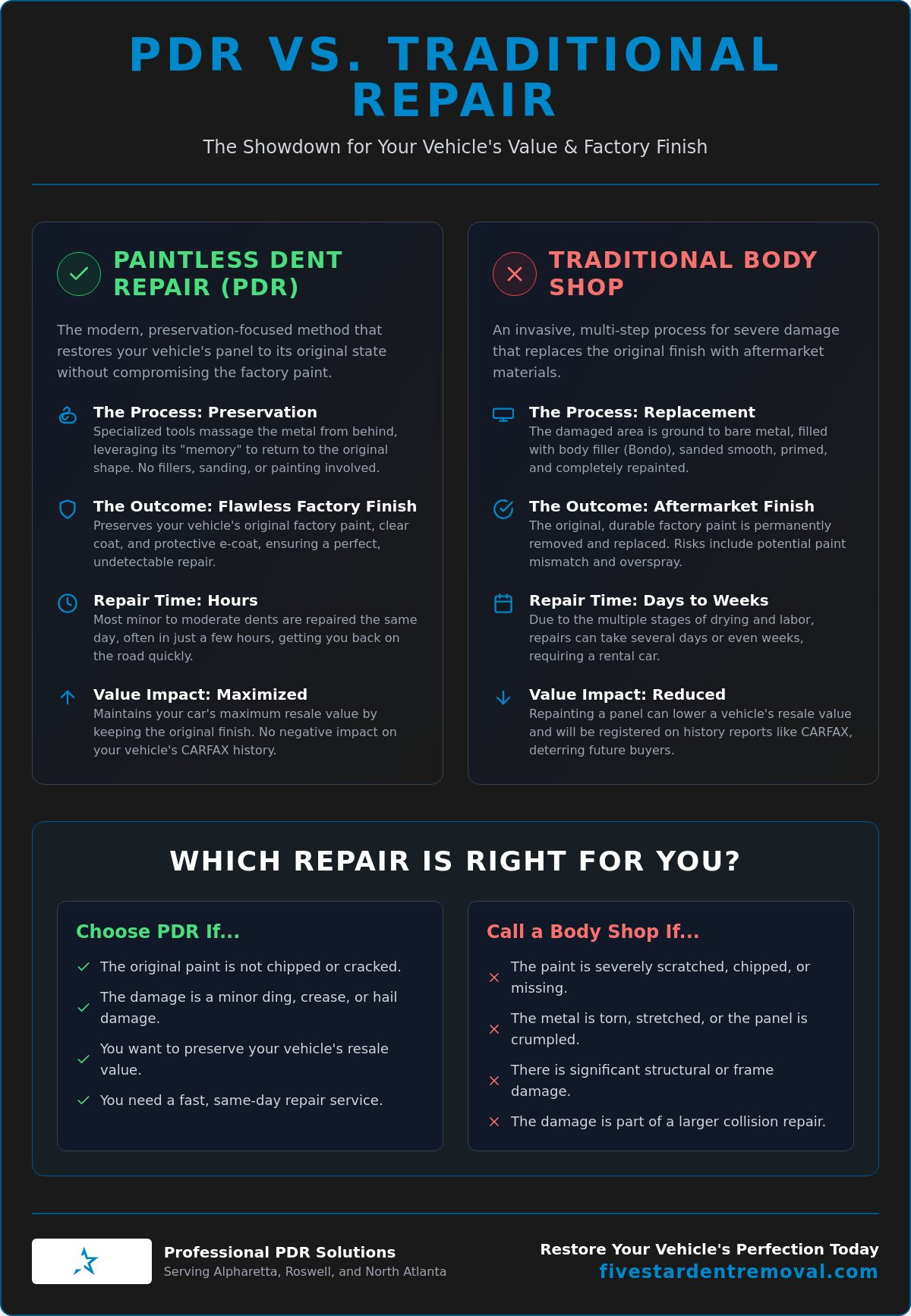
The primary distinction lies in the treatment of the metal and the paint. Traditional repair is an additive process that relies on external materials to hide damage. Conversely, Paintless dent repair (PDR) is a manipulative process that uses specialized tools to massage the metal back to its original factory form. This difference impacts everything from your vehicle’s resale value to how long you’ll be without a car. While a traditional shop often measures turnaround in weeks, a PDR specialist typically measures it in hours.
The Traditional Body Shop Workflow
Conventional repair methods are designed for severe impacts where the metal is torn or the frame is compromised. This workflow is labor-intensive and invasive. It begins with grinding the damaged area down to the bare metal. Technicians then apply polyester body fillers, commonly known as Bondo, to smooth out the surface. Once the filler hardens, it’s sanded down to match the surrounding contours.
- Paint Blending: Because the original finish is destroyed, the shop must respray the entire panel. This requires complex color matching and “blending” into adjacent doors or fenders to hide the transition.
- Structural Necessity: If your vehicle has shredded metal or structural frame damage, this is the only viable path.
- Aftermarket Materials: You lose your factory paint, replacing it with aftermarket primer, basecoat, and clearcoat.
The Modern PDR Workflow
The PDR process is a refined craft that leverages “metal memory.” Every vehicle panel was stamped into a specific shape during manufacturing; PDR technicians use this memory to guide the metal back home. This method is the primary standard for paintless dent repair Alpharetta owners trust to keep their factory finish intact. By accessing the backside of the panel, the technician applies controlled, microscopic pressure to the high and low spots of the dent.
In areas where the backside is inaccessible, such as roof rails or certain door pillars, we utilize “glue pulling.” This involves adhering specialized tabs to the exterior of the paint and using a lifting tool to draw the metal outward. This process uses no chemicals, no fillers, and no sanding. It’s a clean, surgical approach that leaves your vehicle’s original e-coat and factory finish completely undisturbed.
The Technical Difference: Preservation vs. Replacement
The choice between PDR vs traditional dent repair isn’t just a matter of convenience. It’s a technical decision regarding the structural and chemical integrity of your vehicle’s exterior. Every car leaves the factory with a specialized “factory seal” that provides the highest level of protection against the elements. Traditional body shops must compromise this seal to perform their work. They sand through the clear coat, base paint, and the critical e-coat primer to reach the raw metal. Once this factory-applied protection is gone, the panel is more susceptible to environmental degradation.
PDR technicians take the opposite approach. We prioritize preservation. By using highly specialized tools, we restore the panel without disturbing the chemical bonds of the original finish. This ensures your vehicle retains its VIN-matched paint and factory-baked durability. For those concerned with long-term ownership, keeping the original surface is the only way to guarantee a lifetime of rust resistance. If you’re unsure if your damage qualifies, you can consult with a repair specialist to explore your options before choosing an invasive method.
Understanding Metal Memory and Elasticity
Modern automotive panels possess a property known as “metal memory.” During manufacturing, panels are stamped into shape under immense hydraulic pressure. This process creates a specific molecular tension. PDR leverages this tension to guide the metal back to its pre-accident state. A skilled technician understands how to read the “crowns” and “lows” of a dent to release the stored energy without cracking the paint.
However, every material has an elastic limit. If an impact is too sharp or deep, the metal molecules are physically stretched. At this point, the panel loses its ability to “snap” back into place. Preserving factory elasticity is vital for 2026 vehicle standards to ensure body panels maintain their intended aerodynamic and safety performance. When the metal remains within these elastic bounds, PDR is the superior choice for restoration.
The Hidden Cost of Repainting
These inconsistencies are why PDR is the preferred method for luxury car dent repair. High-end vehicles often feature complex multi-stage paint finishes that are notoriously difficult to match in a standard booth. By avoiding the spray booth entirely, you eliminate the risk of overspray on trim pieces and mismatched panels. You keep the car exactly as the manufacturer intended, which is the most effective way to protect your investment.
Financial and Time Impacts: Why PDR Dominates for Minor Damage
Choosing between PDR vs traditional dent repair is a strategic financial decision. Traditional body shops carry high overhead costs due to the materials required for every job. You pay for primer, basecoat, clearcoat, and specialized sanding discs. These shops also bill for the labor hours needed to strip and respray entire panels. PDR eliminates these material expenses entirely. By focusing on the existing metal and paint, you only pay for the technician’s specialized skill and time. This lean process often results in a final bill that is 50% to 70% lower than conventional methods for the same damage.
Time is the second major factor. A traditional body shop often requires your vehicle for 10 to 14 days. This creates an “opportunity cost” involving rental car fees or the logistical headache of being without transportation. Conversely, most PDR projects are completed in a single afternoon. You save money by avoiding rental expenses and minimize the disruption to your daily schedule. For busy professionals in North Atlanta, this rapid turnaround is often as valuable as the direct cost savings.
PDR and Vehicle Equity
The long-term value of your car depends heavily on its history report. Traditional bodywork is almost always flagged as “collision repair” on CARFAX reports. This label can instantly reduce your vehicle’s resale value by thousands of dollars, even if the repair looks perfect. Buyers perceive collision history as a sign of underlying structural issues. PDR is classified as “cosmetic maintenance” or reconditioning. It doesn’t trigger the same red flags because no structural changes or repainting occurred.
Maintaining a clean history report protects your equity. If you want to see how these savings translate to real-world numbers, you can review our guide on the cost of paintless dent repair for specific ROI examples. By keeping the factory finish, you ensure your car remains in the “excellent” category during appraisal rather than being downgraded due to paint work.
Lease Returns and Trade-Ins
Lease returns are a high-stress event for many drivers in Alpharetta and Roswell. Leasing companies use strict “excess wear and tear” guidelines to charge high penalties for small dings. These fees are significantly higher than the cost of a proactive PDR fix. Repairing these imperfections before your inspection ensures you don’t get hit with inflated dealership repair rates.
Decision Matrix: When to Choose PDR and When to Call a Body Shop
Determining the right path for your vehicle is a matter of physics and chemistry. Navigating the choice between PDR vs traditional dent repair requires an honest assessment of the damage. The most important factor is the “Paint Test.” If the paint is cracked, flaking, or missing, a traditional body shop is usually necessary to prevent rust and restore the aesthetic. However, if the paint is 100% intact, you are likely a candidate for a non-invasive restoration that saves both time and money.
The “Depth Factor” is another critical consideration. Metal has an elastic limit. If an impact is extremely deep or sharp, the metal molecules may have stretched beyond their ability to return to their original shape. Similarly, the location of the damage matters. Dents located on the very edges of panels or on reinforced structural pillars can be challenging because access for PDR tools is limited. A professional evaluation is the only way to confirm if these complex areas can be massaged back to perfection without using fillers.
Material composition also dictates the repair strategy. Aluminum panels are increasingly common in 2026 vehicle designs to reduce weight. Aluminum doesn’t have the same “memory” as steel and is much more difficult to manipulate. It requires specialized heat application and specific PDR tools to move the metal without causing it to work-harden and crack. If you have an aluminum-bodied vehicle, ensure you contact a certified PDR specialist who understands these metallurgical nuances.
When PDR is the Clear Winner
Paintless repair is the gold standard for most common road hazards. It is the most effective solution for standard door dings and large, shallow dents where the finish remains undisturbed. It is also the industry-preferred method for hail damage repair, as it preserves the factory roof and hood seals. Modern techniques even allow for expert crease dent repair on body lines, which was once considered impossible without a traditional respray.
When a Traditional Body Shop is Necessary
Conventional methods are still required for severe incidents. If you’ve been in a major collision involving frame damage or air bag deployment, structural safety is the priority. You’ll also need a body shop if the dent is accompanied by deep scratches that reach the primer or bare metal. For plastic bumper repair, traditional shops are necessary when the material is actually torn or punctured, as these require plastic welding and a full respray to look new again.
Professional PDR Solutions in Alpharetta and North Atlanta
Five Star Dent Removal has spent over 20 years mastering the craft of non-invasive automotive restoration. We understand the high standards of North Atlanta vehicle owners who demand perfection. Evaluating the choice between PDR vs traditional dent repair often comes down to who you trust with your vehicle’s chemical and structural integrity. Our specialists provide a level of meticulous attention that conventional body shops simply cannot match. We specialize in luxury and high-end vehicles where maintaining the factory finish is a requirement for preserving equity.
Our estimate process is built around your schedule. You don’t need to waste an afternoon driving across town just to get a quote. Simply send a clear photo of the damage for a pragmatic and honest assessment. This transparent approach ensures you receive expert advice without any hidden costs or unnecessary complications. We tell you exactly what can be achieved through paintless methods. Our goal is to provide a solution that restores your car while respecting your time and investment.
The Convenience of Mobile PDR
For busy North Atlanta professionals, time is the most valuable asset. mobile dent repair Alpharetta services bring a fully equipped restoration shop directly to your door. Whether you are at your office in Roswell or working from home in Alpharetta, we perform the repair on-site while you focus on your day. This mobile capability eliminates the logistical headache of traditional repair methods.
A successful mobile fix requires specific conditions and elite equipment. We utilize high-intensity LED reflection boards and precision-engineered hand tools to ensure the metal is perfectly leveled. You can expect a professional, quiet session that typically concludes in just a few hours. There is no need for the logistical stress of a traditional shop drop-off or the expense of a rental car. We provide the highest standard of quality in your own driveway, ensuring your vehicle never has to leave your sight.
Ready for a Five Star Restoration?
Don’t settle for a weeks-long body shop stay and a permanent history report flag. Choosing PDR vs traditional dent repair means you avoid the invasive sanding and filling that devalues your investment. You keep your original paint, your factory e-coat, and your car’s maximum resale value. We take immense pride in our craftsmanship and our reputation as a dependable local specialist who values quality over volume.
Our team is ready to help you restore your vehicle’s appearance with speed and honesty. Contact us today to see if your damage qualifies for a specialized PDR solution. We prioritize your vehicle’s value and your busy schedule, ensuring a seamless experience from the initial photo to the final flawless result. Trust your car to the seasoned specialists at Five Star Dent Removal.
Restore Your Vehicle with Specialized Expertise
Choosing between PDR vs traditional dent repair is ultimately a choice about your car’s future value. You now understand that preserving the factory paint and leveraging metal memory is the most effective way to avoid invasive bodywork and permanent history report flags. For minor dings, creases, and hail damage, the non-invasive approach offers a faster, more cost-effective resolution that respects your time and your vehicle’s integrity.
Five Star Dent Removal brings over 20 years of industry experience to every repair. We specialize in luxury and high-end vehicles that require a meticulous touch. Our mobile service across Alpharetta, Roswell, and North Atlanta ensures you receive professional results without the inconvenience of a traditional body shop stay. Don’t let a minor dent lower your resale value.
Take the first step toward a flawless finish today. Request a Free PDR Estimate from Five Star Dent Removal and get an honest, expert assessment of your damage. We look forward to restoring your vehicle to its original factory condition.
Frequently Asked Questions
Is PDR really better than a traditional body shop for small dents?
PDR is the superior choice for small dents because it maintains the vehicle’s original factory finish and structural integrity. Traditional body shops must grind away the paint and use fillers; this is an invasive process for minor damage. By choosing the paintless route, you avoid the risk of mismatched paint colors and keep your car’s exterior exactly as the manufacturer intended.
Does Paintless Dent Repair last as long as a traditional repair?
Paintless Dent Repair is a permanent solution that lasts for the life of your vehicle. Unlike traditional repairs that use body fillers which can shrink or crack over several years, PDR restores the actual metal to its original shape. Once the metal is massaged back into place, it won’t pop back out or change form unless the vehicle sustains another impact.
Will my insurance cover PDR vs. traditional body work?
Most insurance companies fully cover PDR as a preferred method for hail damage and minor impacts. When comparing PDR vs traditional dent repair, insurance adjusters often prefer the paintless route because it is more cost-effective and preserves the vehicle’s value. In many cases, the cost of a PDR repair is lower than your deductible, allowing you to avoid a claim entirely.
Can PDR fix dents on a body line where the metal is strongest?
Specialized technicians can successfully repair dents on body lines using advanced leverage tools and heat. While these areas are structurally stronger and more difficult to manipulate, modern PDR techniques allow for precise restoration of these sharp creases. It requires a higher level of skill than a standard door ding, but it eliminates the need for the heavy sanding used in traditional shops.
Why do body shops often recommend traditional repair over PDR?
Traditional body shops are often geared toward large-scale collision work and may not have a certified PDR specialist on staff. They rely on higher material markups from paint and body filler to maintain their business model. Recommending a full panel respray is more profitable for their specific workflow, even if a non-invasive PDR solution would be better for the vehicle’s long-term value.
Is PDR possible if the paint has a very small scuff but isn’t cracked?
PDR is still possible if the paint has a minor surface scuff that hasn’t penetrated the clear coat. A technician can often perform the metal restoration and then professionally polish the scuffed area to restore the shine. If the paint is physically missing, flaking, or cracked down to the primer, you’ll likely need the respraying services of a traditional body shop.
How much money can I save by choosing PDR over a traditional shop?
Choosing PDR typically saves you between 50% and 70% compared to the cost of a traditional body shop repair. These savings come from the total elimination of expensive paint materials, primers, and the heavy labor hours required for sanding and blending. Because the process is so efficient, you also save on secondary costs like rental car fees and lost time.
Will a PDR repair show up on my car’s CARFAX report?
PDR repairs typically don’t appear on CARFAX reports because they’re considered cosmetic maintenance rather than a collision repair. Traditional body shops often report repairs to insurance databases, which then flag the vehicle’s history. By paying for a PDR restoration out of pocket, you keep your vehicle’s history clean and protect its maximum resale value for future buyers.