

What if that tiny rock chip isn’t just a cosmetic blemish, but a ticking clock that could eventually cost you over $1,500 in replacement and ADAS recalibration fees? You’re likely staring at that mark right now, wondering if it’s safe to drive or if the next Georgia temperature swing will snap the glass. It’s a frustrating situation that demands a fast, honest answer before physics takes over and forces a total windshield overhaul.
We understand the urgency of protecting your vehicle’s structural integrity and your time. This 2026 guide delivers expert clarity on whether a professional rock chip repair on windshield is your best move or if a full replacement is unavoidable. You’ll learn exactly how the professional resin injection process works, what insurance shifts mean for your wallet this year, and how mobile specialists bring the solution directly to your location. We’ll show you how to stop the crack, restore your visibility, and avoid the massive headache of modern sensor recalibration by acting while the damage is still small.
Key Takeaways
- Identify why small breaks spread and how the windshield’s safety layers react to Georgia temperature fluctuations.
- Apply the “Quarter Rule” to quickly assess if your glass damage is eligible for a cost-effective repair versus a full replacement.
- Understand why professional vacuum technology and high-viscosity resins outperform generic DIY kits for long-term clarity.
- Discover how a timely rock chip repair on windshield prevents the need for complex and expensive ADAS sensor recalibrations.
- Learn how mobile specialists across North Atlanta provide expert resolution without the hassle of a shop visit.
What Exactly is a Rock Chip and Why Does it Spread?
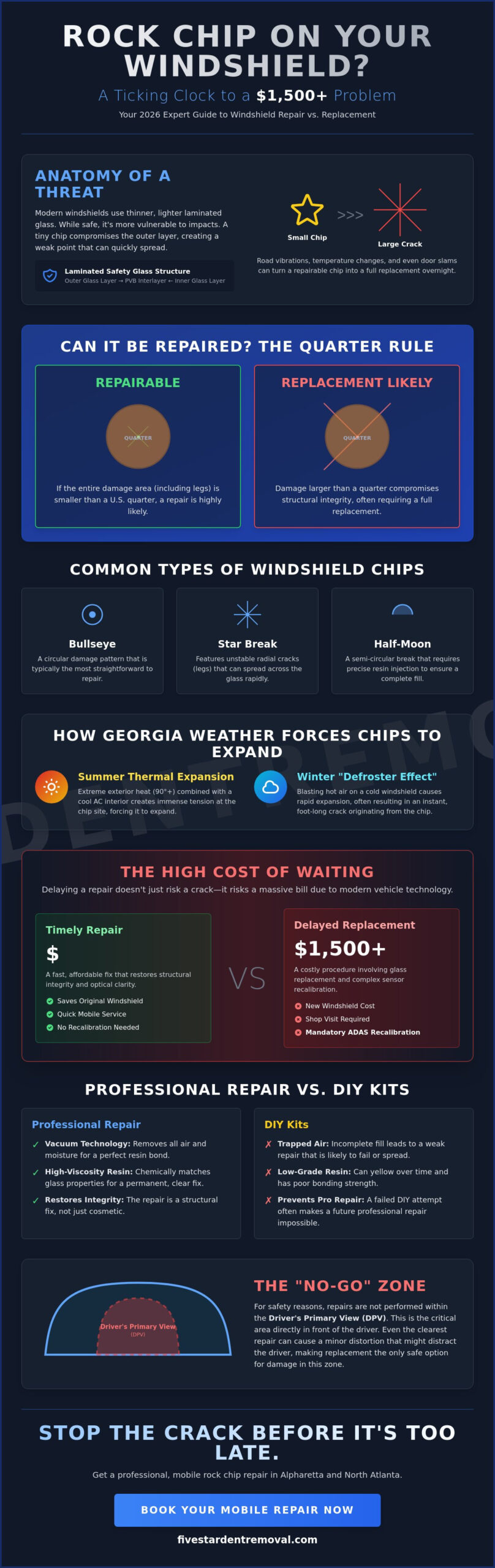
A rock chip is a physical breach in the outer layer of your vehicle’s glass. It occurs when a high-velocity object, usually a stone thrown by another vehicle, strikes the surface with enough force to displace glass fragments. Modern windshields are not a single solid pane; they are constructed from laminated safety glass. This specialized structure consists of two layers of glass bonded together by a Polyvinyl Butyral (PVB) interlayer. While the PVB layer is designed to keep the glass from shattering into dangerous shards during an accident, it also creates a pocket where air and moisture can become trapped after an impact.
In 2026, vehicle glass is becoming increasingly vulnerable. Manufacturers are utilizing thinner glass to reduce overall vehicle weight and extend the range of electric vehicles. This weight-saving measure means your windshield has less mass to absorb road debris impacts than older models. Every rock chip is essentially a ticking time bomb. Road vibrations, door slams, and even the pressure changes from driving at highway speeds act as a silent hammer. These forces constantly stress the weakened area, making a rock chip repair on windshield a race against physics.
Common Types of Windshield Chips
- The Bullseye: This is a circular damage pattern with a dark ring around the impact point. It is usually the most straightforward to fix because the break is contained.
- The Star Break: This type features small radial cracks extending from the center. These “legs” are highly unstable and can spread across the entire glass surface in minutes. Understanding the full scope of windshield star chip repair is essential if you’re dealing with this particularly aggressive damage pattern.
- The Half-Moon: A semi-circular impact caused by blunt stones hitting at an angle. These require precise resin placement to ensure the entire void is filled.
How Georgia Weather Forces Chips to Expand
The local climate in Georgia presents unique challenges for damaged glass. Thermal expansion is a primary driver of chip growth. During 90-degree Atlanta summers, the exterior glass expands significantly while your interior remains cool from the air conditioning. This temperature differential creates massive tension at the site of the chip. Seeking a rock chip repair on windshield before the peak of summer is a critical preventative step.
The “Defroster Effect” is equally dangerous during North Atlanta winters. When you blast hot air onto a frost-covered windshield, the sudden heat causes the glass to expand rapidly. If a chip is present, the stress often results in an instant, foot-long crack. Additionally, Georgia’s high humidity leads to hydrostatic pressure. Moisture enters the chip and, if temperatures drop, that water freezes and expands. This internal pressure forces the glass layers apart, turning a simple repair into a mandatory replacement.
Evaluating Your Damage: Can Your Rock Chip Be Repaired?
Determining if a rock chip repair on windshield is possible starts with a simple measurement. The “Quarter Rule” is the industry standard for a reason. If the entire impact area, including any small radiating legs, fits beneath a standard U.S. quarter, a professional repair is usually successful. Once the damage exceeds this diameter, the structural integrity of the outer glass layer is too compromised for resin to bridge the gap reliably. It’s a matter of physics; larger breaks lack the surface tension required to hold the repair under pressure.
Depth is the second critical factor. A repair is only viable if the damage is confined to the outer layer of the glass. If the impact was severe enough to reach or puncture the plastic PVB interlayer, the windshield’s internal seal is lost. This often happens with heavy debris or high-speed collisions on Georgia interstates. The number of existing repairs also matters. Most specialists won’t perform a fourth repair on a single piece of glass. The cumulative weakness eventually violates safety thresholds and compromises the vehicle’s structural frame.
Contamination is the silent killer of successful repairs. Rain, road salt, and even windshield washer fluid carry microscopic debris into the break. This material creates a barrier that prevents professional resin from bonding to the glass. If you can’t get to a specialist immediately, placing a small piece of clear tape over a dry chip can preserve the success rate of your rock chip repair on windshield. Keeping the “wound” clean ensures the resin can fill every microscopic fissure for a clear, strong result.
The No-Go Zones for Windshield Repair
Location is just as important as size. Any damage within the Driver’s Primary View (DPV) is generally unrepairable. This is the area roughly covered by the windshield wipers directly in front of the steering wheel. Even the best resin leaves a slight optical distortion. This blemish can distract the driver or catch glare from oncoming headlights at night. Chips located within two inches of the black ceramic frit at the edge of the glass are also high-risk. These areas experience the most vibration and temperature stress. They often snap during the repair process due to the localized pressure of the equipment.
Identifying ‘Unrepairable’ Cracks
Distinguishing between a minor surface pit and a structural crack is vital. A surface pit is a shallow nick where no actual break has occurred in the glass. These are mostly cosmetic and don’t threaten the glass. However, a dark line or a shimmering reflection indicates the glass has separated. Cracks longer than six inches typically require a full replacement to meet Federal Motor Vehicle Safety Standards. Attempting to force resin into long, old cracks often results in spider-webbing. This happens when the pressure of the injector tool causes the crack to race across the glass instantly. If you’re unsure about the severity, a quick assessment for professional windshield repair can prevent a costly and unnecessary replacement.
Professional Windshield Repair vs. DIY Kits: Is it Worth the Save?
Choosing between a store-bought kit and a professional service often feels like a choice between saving a few dollars or saving the entire windshield. While 2026 DIY kits offer improved resin formulas, they cannot replicate the physics of professional grade equipment. The most critical difference is the vacuum factor. A professional rock chip repair on windshield isn’t just about pushing glue into a hole. It’s about removing every microscopic air pocket before the resin enters. DIY kits rely on simple gravity or manual plungers that often trap air inside the break. These trapped bubbles act as internal stress points that eventually lead to a full crack during the next Georgia heat wave.
Optical clarity is where the professional difference becomes visible. High-grade resins used by specialists are engineered to match the refractive index of automotive glass. This results in a 90-95% invisible finish that restores your line of sight. In contrast, generic store-bought liquids are often one-size-fits-all. They may appear clear initially but frequently develop a yellowish tint or a blurry, matte texture after six months of sun exposure. Long-term durability is the final hurdle. Professional repairs create a permanent molecular bond. DIY patches are prone to popping out during rapid temperature shifts because the resin failed to penetrate the microscopic fissures of the break.
The Physics of the Professional Injection Process
Professional technicians use a specialized bridge tool that creates a hermetic seal over the impact point. This allows for a precise cycling process. First, the tool pulls a deep vacuum to extract air and moisture from the PVB interlayer. Next, it switches to a high-pressure injection phase to force resin into the deepest parts of the damage. The final step involves controlled UV curing. Using a specific wavelength of light, the technician triggers a chemical reaction that hardens the resin instantly. This creates a stronger, more stable molecular bond than air-drying alternatives found in retail kits. This vacuum-pressure injection method is especially critical for professional windshield star chip repair, where multiple radiating legs must be fully saturated with resin to prevent further spreading.
Hidden Risks of DIY Windshield Repair
The biggest risk of a self-repair is the “One Shot” Rule. Once you inject resin into a chip and it cures, the repair is permanent. If you trap air or fail to fill the legs of a star break, a professional cannot simply undo your work to fix it. You’ve essentially sealed the flaw into the glass forever. Additionally, applying too much pressure with a DIY plunger can cause the damage to spread instantly. This turns a simple rock chip repair on windshield into a mandatory replacement. Saving a small amount on a kit often results in a much larger bill for new glass and complex ADAS recalibration.
The Professional Repair Process: What to Expect in 2026
A professional rock chip repair on windshield follows a methodical sequence that prioritizes glass stability. It begins with a meticulous pre-inspection to clear loose glass shards and road grime from the impact point. Technicians must ensure the break is bone-dry. In humid climates like North Atlanta, moisture trapped inside a chip can ruin the resin’s bond. If the break is particularly tight, a specialist might use a micro-drill to create a precise entry point. This is a controlled surgical step. It ensures the resin reaches the deepest fissures of the damage without causing further stress to the glass.
Once prepared, the technician applies a specialized injection bridge. They cycle between vacuum and pressure phases to force out air and pull in high-viscosity resin. The process continues until the dark shadow of the break disappears. After the internal void is filled, a pit resin is applied to the surface to seal the impact point. This material is cured with a high-intensity UV lamp for several minutes. The final stage involves scraping away excess resin with a precision blade and polishing the spot to a smooth finish. This restores the aerodynamic profile of the glass and prevents wiper blade wear.
How Long Does a Professional Repair Take?
Efficiency is a hallmark of modern glass service. Most repairs are completed within a 30-minute window. It’s a pragmatic solution for busy drivers in Alpharetta or Roswell who need to resolve damage without losing their entire day. Mobile specialists often perform these repairs at your home or office, eliminating the need for a shop visit. Once the UV curing process is complete, the resin reaches its full structural strength instantly, allowing you to drive the vehicle immediately without any wait time.
Cost, Insurance, and Value Retention
Financially, repairing a chip is the most sensible automotive maintenance you can perform. Most insurance providers waive the deductible for these services because it prevents a more expensive replacement claim later. This cost-effective approach is similar to how the cost of paintless dent repair saves owners from traditional body shop fees. Beyond the immediate price, you preserve the factory seal. Original windshields are bonded to the frame with high-strength urethane that contributes to the vehicle’s structural rigidity. Keeping the original glass means you don’t risk the leaks, wind noise, or ADAS calibration issues often associated with aftermarket replacements. If you want to protect your vehicle’s value, you can request a mobile windshield repair quote to secure your glass before the damage spreads.
Expert Rock Chip Repair in Alpharetta and North Atlanta
Five Star Dent Removal brings a pragmatic, solution-oriented approach to automotive maintenance across North Atlanta. We recognize that a rock chip isn’t just a minor eyesore; it’s a direct threat to your vehicle’s safety and resale value. Our technicians specialize in high-precision rock chip repair on windshield designed to stop damage before physics takes over. By focusing on structural restoration rather than just cosmetic patches, we ensure your glass remains strong enough to withstand the rigors of daily highway driving. Our mobile service units operate throughout Alpharetta, Roswell, and Cumming, bringing professional-grade equipment directly to your driveway or office parking lot.
One distinct advantage of working with Five Star Dent Removal is our ability to address multiple cosmetic issues in a single visit. Many of our clients choose to bundle their glass service with paintless dent repair Alpharetta. This comprehensive approach allows you to restore your vehicle’s exterior and visibility simultaneously, saving you the annoyance of multiple appointments. We are committed to preserving your vehicle’s original factory components whenever possible. Keeping your original windshield means you avoid the risks of improper aftermarket seals and the massive expense of sensor recalibration. It’s a faster, smarter way to maintain your car’s integrity.
Why Local Expertise Matters for North Atlanta Drivers
Driving in North Atlanta presents specific hazards that national chains often overlook. Construction debris along GA-400 is a constant source of impact damage for local commuters. Our team understands these regional challenges and the extreme urgency they create. In the intense Georgia heat, a small chip can transform into a full-length crack in a matter of hours. Our local presence allows for rapid response times, ensuring we perform a rock chip repair on windshield before the damage becomes unfixable. You receive personalized service from specialists who live in your community and take pride in maintaining the area’s vehicles.
Ready to Restore Your View?
Starting the restoration process is straightforward and transparent. You can obtain a quick, photo-based estimate by sending us a clear image of the damage. This allows our technicians to verify repairability and provide a clear ‘yes or no’ before we even arrive. Every service is backed by the Five Star guarantee on structural integrity, providing you with long-term peace of mind. Don’t wait for a temperature swing to snap your glass. Contact us today for professional windshield repair Alpharetta GA and experience a more reliable way to care for your vehicle.
Secure Your Glass Before the Next Temperature Shift
A small impact doesn’t have to lead to an expensive replacement bill. By choosing a professional rock chip repair on windshield, you effectively halt the spread of damage and protect your vehicle’s structural integrity. You’ve learned that acting fast is the only way to beat the “Defroster Effect” and that professional vacuum technology far exceeds the capabilities of any DIY kit. Preserving your original factory glass seal is the best way to maintain your vehicle’s value and avoid the complexities of modern sensor recalibration.
Five Star Dent Removal brings over 20 years of professional industry experience directly to your location. Our mobile service covers the entire North Atlanta region, providing a specialized solution that values your time and your vehicle’s craftsmanship. We focus on high-quality results that keep your factory components intact and your visibility clear.
Save your windshield today; contact Five Star Dent Removal for a professional chip repair estimate.
Don’t let a minor road hazard turn into a major repair. Take control of your glass health now and drive with total confidence through every Georgia season.
Frequently Asked Questions
Is rock chip repair on a windshield permanent?
Yes, a professional repair is a permanent fix. The specialized resin creates a molecular bond with the glass that won’t pop out or degrade over time. This process restores the structural integrity of the pane and prevents the damage from spreading into a full-length crack. It’s a one-time solution that lasts for the remaining life of the windshield.
Can I wash my car immediately after a rock chip repair?
You can wash your car immediately after the service is complete. Because technicians use high-intensity UV lamps to cure the resin instantly, the repair reaches its maximum strength before the specialist even leaves your driveway. There is no “cure time” required for a professional rock chip repair on windshield, unlike the 24-hour wait often associated with full glass replacements.
Will the rock chip completely disappear after the repair is finished?
The impact point won’t completely vanish, but you can expect a 90% to 95% improvement in optical clarity. A small, faint mark similar to a dried water spot usually remains where the stone struck the glass. The primary goal is structural stabilization; the cosmetic improvement is a secondary benefit that restores your safe line of sight.
What happens if the rock chip spreads during the repair process?
If the glass snaps during the injection process, the windshield will require a full replacement. While this is rare, the pressure required to force resin into tight fissures can occasionally cause an unstable chip to “run.” Professional technicians pre-inspect the glass to minimize this risk, but existing internal stress in the glass can sometimes be unpredictable.
Does a windshield chip repair count as an insurance claim?
A rock chip repair on windshield is technically an insurance claim under your comprehensive coverage. However, most Georgia insurance providers don’t count this as a “fault” accident and won’t raise your premiums. Many companies waive your deductible entirely for repairs because it prevents the much higher cost of a total windshield replacement and ADAS recalibration.
How long can I wait before a rock chip becomes unrepairable?
You should address the damage within 24 to 48 hours to ensure the best results. Over time, road grime, washer fluid, and dust settle into the break, creating a barrier that resin cannot penetrate. The longer you wait, the higher the chance that a Georgia temperature swing will turn that small chip into an unrepairable crack.
Can you repair a rock chip if it is raining or the glass is wet?
A technician cannot perform the repair while the glass is actively wet. Moisture inside the break prevents the resin from bonding to the PVB interlayer. If it’s raining, the repair must be done under a shelter, or the technician must use specialized drying tools to ensure every microscopic drop of water is removed before the injection phase begins.
Will a repaired rock chip pass a vehicle safety inspection?
A professionally repaired chip will pass a standard safety inspection as long as it’s not in the Driver’s Primary View. Modern safety standards focus on whether the driver’s vision is obstructed or if the glass’s structural integrity is compromised. Since the resin restores the strength of the laminated safety glass, the vehicle remains compliant with federal regulations.