

That door ding isn’t just a minor eyesore; it’s a direct tax on your car’s resale value every day you leave it there. You’ve likely stared at a fresh dent and worried about massive body shop bills or mismatched paint. We understand that frustration. If you’re asking is paintless dent repair worth it, you’re already looking for a way to protect your investment without the unnecessary complications of traditional repair.
This guide will prove that PDR is a value-preservation strategy that pays for itself through resale protection and avoided lease-end fees. You’ll learn why 80% to 90% of minor dings are fixable without fillers and how mobile dent repair keeps your factory finish intact. We’ll examine the 2026 ROI of specialized repair methods, the impact of aluminum panel upcharges, and how to choose the right solution for your vehicle’s long-term value.
Key Takeaways
- Protect your vehicle’s most valuable exterior asset by maintaining the original factory paint and avoiding body fillers.
- Learn how specialized repair costs often fall below standard insurance deductibles, saving you from unnecessary premium hikes.
- Discover why modern techniques handle more than just small dings, including complex creases and significant hail damage.
- Evaluate the specific financial scenarios that determine if is paintless dent repair worth it for your upcoming lease return or trade-in.
- Identify the critical markers of a qualified specialist to ensure a high-quality restoration that lasts the life of your vehicle.
Defining the Value: What Makes Paintless Dent Repair Worth It?
Vehicle damage is a frustrating reality for every car owner. When a stray shopping cart or a sudden hailstorm leaves its mark, you need a solution that balances cost with quality. Paintless Dent Repair (PDR) is the specialized process of removing dents without the use of sanding, body fillers, or repainting. Unlike traditional methods, it keeps the vehicle’s structural integrity completely untouched. If you’re wondering is paintless dent repair worth it, the answer lies in the speed and precision of the process. Most repairs take just a few hours. You don’t have to leave your car at a shop for weeks. It’s an “invisible repair” that restores the metal to its original shape. This method ensures that the car looks exactly as it did before the damage occurred.
The Core Mechanism of PDR
Technicians use specialized tools to gain access behind the damaged panel. By applying precise pressure, they slowly massage the metal back into its factory form. This process relies on “metal memory,” where the panel naturally wants to return to its original stamped shape. It’s vastly different from the “grind and fill” approach. Traditional shops often sand down your paint and use plastic fillers to hide the damage. To understand the history and technical evolution of this craft, you can read more about What is Paintless Dent Repair? in detail. If your paint isn’t cracked or missing, this non-invasive method is almost always the superior choice. It addresses the root of the problem rather than masking it with synthetic materials that can fail later.
Why Original Paint Matters in 2026
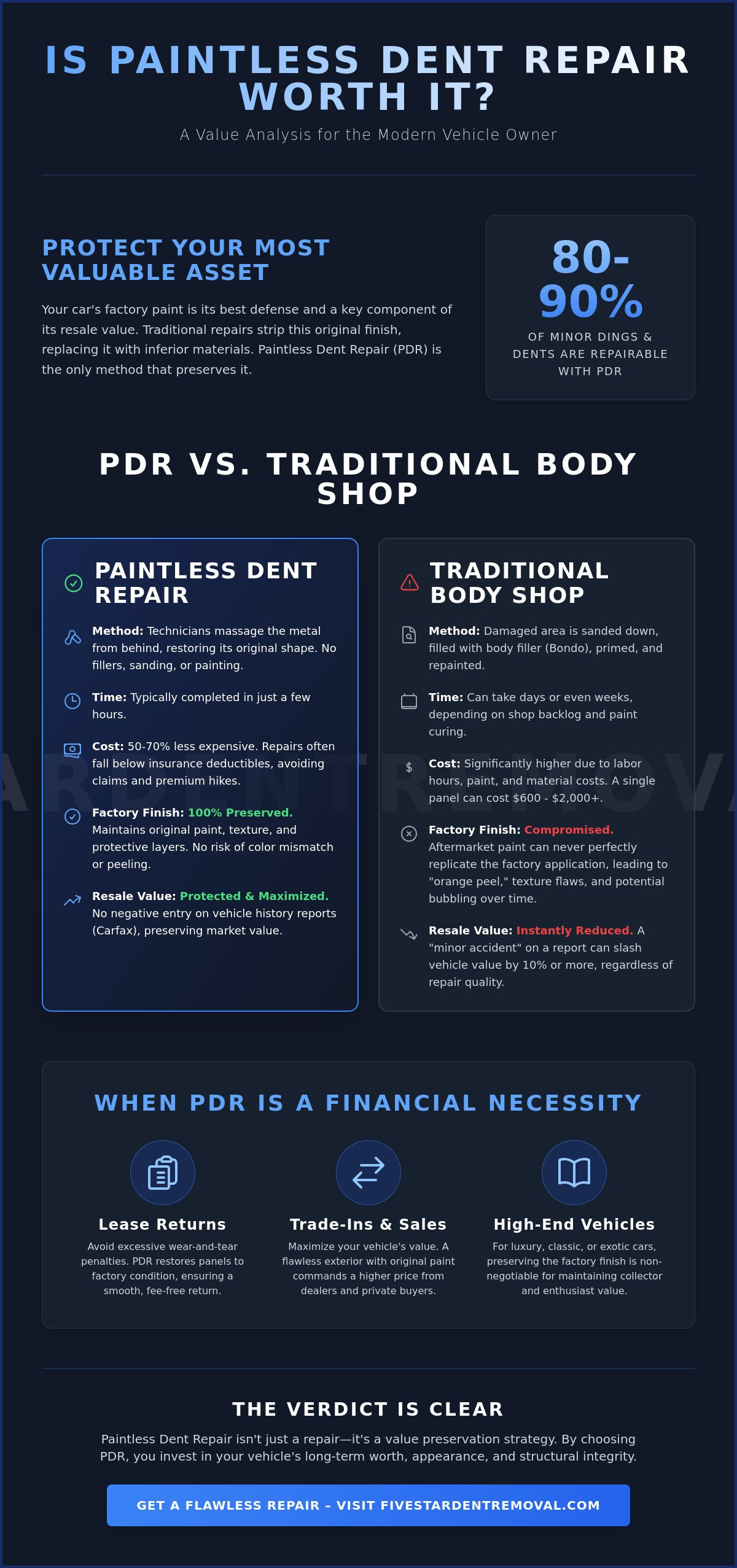
Your car’s factory finish is the most valuable part of its exterior. Modern automotive paints are applied in highly controlled, dust-free environments using robotic precision and high-heat curing. This level of quality can’t be replicated in a standard repair stall. When a panel is resprayed, it often develops “orange peel” textures or slight color mismatches that become visible under direct sunlight. These flaws signal to future buyers that the car was in an accident, which hurts your bottom line. Choosing PDR ensures that PDR preserves the factory warranty, which is a major factor when deciding is paintless dent repair worth it for a late-model vehicle. By avoiding harsh chemicals and aftermarket paints, you maintain the vehicle’s long-term durability. You also avoid the risk of paint peeling or bubbling years after the repair is finished. This preservation of the original surface is the ultimate goal of any high-end restoration.
The Financial Math: PDR Costs vs. Traditional Body Shops
Traditional body shops operate with massive overhead. They must account for paint booths, expensive chemical supplies, and replacement panels. These costs are passed directly to you, regardless of how small the damage is. Paintless Dent Repair removes these variables from the equation entirely. Because there are no sanding or repainting steps, you aren’t paying for materials that your car doesn’t actually need. When you evaluate if is paintless dent repair worth it, consider that PDR is generally 50% to 70% less expensive than traditional methods. For a single panel, traditional repair can cost between $600 and $2,000. PDR achieves the same structural result without the heavy material markup.
Direct Cost Comparison
Labor rates at traditional collision centers reflect the complexity of matching factory paint. It involves hours of blending and curing. In contrast, the cost of paintless dent repair is driven by the technician’s skill and the time spent massaging the metal. A standard door ding repair via PDR avoids the steep labor and material costs associated with traditional paint matching. For a deeper look at specific pricing factors, check our 2026 PDR cost guide to see how severity and location impact the final investment. Before committing to any repair, getting an accurate paintless dent repair estimate helps you understand how variables like panel access, dent depth, and steel versus aluminum construction affect your specific quote.
Avoiding the Insurance Claim Trap
Filing an insurance claim for a minor dent is often a financial mistake. Most PDR services cost less than a standard $500 or $1,000 deductible. By paying out-of-pocket, you keep your claims history clean. This prevents potential premium hikes that can cost you thousands over several years. Perhaps more importantly, PDR keeps the incident off your Carfax report. A reported “minor accident” can slash your vehicle’s resale value by 10% or more instantly. Keeping your vehicle history report spotless is a primary reason why is paintless dent repair worth it for owners of high-end or late-model cars.
Time is a finite resource. For professionals in the North Atlanta region, losing a vehicle for two weeks is a major logistical headache. PDR offers a “Time is Money” advantage that traditional shops can’t match. Many repairs are completed during a single work day. This efficiency, combined with the protection of your trade-in value, makes it the logical choice. If you’re ready to restore your car’s appearance without the body shop hassle, consider our mobile dent repair services for maximum convenience. Protecting your investment shouldn’t require a week in a rental car.
Busting 4 Common Myths That Make Owners Question PDR
Misconceptions often cloud the decision-making process for vehicle owners. If you’re skeptical about whether is paintless dent repair worth it, you’ve likely heard a few industry myths. These range from misunderstandings about physics to dangerous DIY advice found on social media. Clearing up these falsehoods is essential to protecting your car’s long-term value and avoiding costly mistakes at the body shop.
Many people believe a popped-out dent will eventually revert to its damaged state. This simply isn’t how automotive metal works. Others assume PDR is strictly for tiny door dings. In reality, highly skilled technicians now tackle large body dents and sharp creases that were once considered “total panel losses” by traditional shops. Another common worry is durability. Some owners think a resprayed panel is tougher. Actually, your original factory clear coat is the hardest, most resilient layer your car will ever have. Sanding it off to apply aftermarket paint reduces the vehicle’s resistance to environmental damage.
The Truth About Metal Memory
Metal possesses a property often called “memory,” but it works in your favor during a professional repair. When a specialist uses tools to massage the panel, they’re realigning the molecules to their original stamped position. Once professionally massaged back to its original state, it stays there. A professional PDR repair is permanent and structurally sound. Only a new impact or extreme structural stress will cause a new dent in that location. To learn more about the technical history behind what is paintless dent repair, industry records show the process has been refined since the mid-20th century to ensure permanent results. It’s a proven science, not a temporary fix.
The Danger of DIY Suction and Glue Kits
The rise of cheap repair kits has led to more damaged cars than ever before. These kits are the primary danger to your vehicle’s resale value. Without proper training, it’s easy to apply improper pressure and “stretch” the metal. Once metal is stretched, it can’t be massaged back; it becomes a permanent high spot that requires expensive traditional bodywork. Glue pulling also carries massive risks. If you use a DIY kit on a panel with even a tiny rock chip, you risk pulling the paint right off the clear coat. A small DIY mistake often doubles the price of a professional repair. The technician now has to fix your “fix” before they can address the original damage. This is a key factor when considering if is paintless dent repair worth it; doing it right the first time is always the cheapest option.
High-Stakes Scenarios: When PDR is a Financial Necessity
Repairing a dent isn’t always about vanity. In several high-stakes situations, it’s a strategic financial move to protect your equity. If you’re nearing the end of a lease or preparing to sell your vehicle, the question of is paintless dent repair worth it becomes a simple calculation of avoided fees and increased profit. In these moments, the cost of the repair is far lower than the financial penalty of doing nothing.
Winning the Lease Return Game
Leasing companies are notoriously strict during the final inspection. They categorize damage as either “normal” or “excessive wear and tear.” Usually, any dent larger than a credit card, or multiple dings on a single panel, will trigger a hefty charge. Dealerships often bill for full panel resprays at premium labor rates for damage that could have been fixed for a fraction of the price. We recommend fixing dents for lease returns approximately 2 to 4 weeks before your turn-in date. This proactive approach ensures you pass the inspection without surprise invoices appearing in your mail a month later.
Maximizing Trade-In and Private Sale Value
First impressions dictate the entire negotiation. A clean, dent-free exterior signals to a buyer that the vehicle was meticulously maintained. On the other hand, dealers use minor dings as psychological leverage. They might point to a $150 door ding and use it to justify a $1,000 reduction in their trade-in offer. By investing in dent repair for trade-in value, you remove their primary bargaining chip. Whether you’re selling to a neighbor in North Atlanta or trading up at a dealership, a straight body panel is the fastest way to secure a top-dollar offer. It’s a small upfront investment that pays for itself several times over at the closing table.
For luxury brands like BMW, Tesla, and Porsche, PDR is the only acceptable repair method. These vehicles feature specialized paint finishes and complex sensors that traditional body shops often struggle to replicate or calibrate. Similarly, PDR is the industry standard for hail damage recovery. Since hail damage accounted for 34.6% of the PDR market in 2025, insurance companies prefer this method because it maintains the factory seals. If your vehicle has suffered storm damage or a parking lot mishap, is paintless dent repair worth it? Absolutely. It preserves the car’s history and structural integrity. If you’re ready to maximize your car’s value, contact Five Star Dent Removal for a professional assessment today.
The Verdict: How to Ensure Your PDR is Worth the Price
Deciding whether is paintless dent repair worth it comes down to a simple inspection of the damage. If the paint remains intact and the metal isn’t severely stretched, PDR is the undisputed winner for cost, speed, and quality. It bypasses the invasive “grind and fill” methods used by traditional collision centers. This ensures your vehicle remains in its original factory condition. Choosing PDR isn’t just about fixing a dent; it’s about making a strategic choice to protect your car’s long-term equity. When the process is performed correctly, the repair is permanent and completely invisible to the naked eye.
Vetting Your Technician
Precision requires the right combination of skill and specialized equipment. High-quality PDR relies on specialized LED lighting arrays that reveal the minute details of the metal’s surface. Without these tools, a technician cannot see the fine textures required for a perfect finish. Look for high-resolution galleries showing “before and after” crease repairs on a business’s website. These galleries demonstrate a technician’s ability to handle complex body line dents where the metal is most rigid. Verify that the business is established and offers mobile convenience for Alpharetta residents. Ask about their satisfaction process and how they handle complex repairs. A reputable specialist will be transparent about the expected outcome before they ever touch your vehicle. Requesting a detailed paintless dent repair estimate upfront is one of the clearest signs that a technician values transparency and respects your investment.
Five Star’s Commitment to Value
Five Star Dent Removal represents the standard of quality for the North Atlanta region. Our reputation is built on 20+ years of experience navigating the specific needs of local car owners. We provide a blend of shop-quality precision with mobile service flexibility, allowing you to get expert results at your home or office. We understand that your time is valuable. Our process is designed to be efficient, professional, and entirely transparent. We use advanced tools to ensure every repair meets a standard that protects your vehicle’s factory warranty and resale price.
Protecting your vehicle’s resale value starts with choosing the right repair method. By avoiding the sanding and repainting process, you keep your car’s history report clean and its exterior original. Ultimately, PDR protects your investment for the life of the vehicle. By choosing a reliable regional specialist, you ensure that is paintless dent repair worth it isn’t just a question, but a confirmed financial victory. Avoid the hidden costs and long wait times of traditional body shops. Choose the method that respects your car’s factory finish and your personal schedule.
Take Control of Your Vehicle’s Resale Value
Determining is paintless dent repair worth it for your specific situation requires looking at the long-term math. You’ve seen how PDR protects your factory finish and keeps your vehicle history report clean. It eliminates the risk of color mismatches and prevents costly lease return penalties. By choosing a non-invasive restoration method, you ensure that your car maintains its maximum trade-in value without the heavy overhead of traditional body shop labor.
Five Star Dent Removal brings 20+ years of professional PDR experience directly to you. As expert hail and crease repair specialists, we understand the precision required for high-end vehicles in Alpharetta, Roswell, and North Atlanta. Our process is designed to be efficient and reliable, giving you shop-quality results with mobile convenience. Don’t let a minor ding turn into a major loss of equity.
Get a Free PDR Estimate from Five Star Dent Removal Today and restore your vehicle’s appearance with confidence. Your car deserves a specialist who values quality as much as you do.
Frequently Asked Questions
Does paintless dent repair show up on a Carfax report?
Paintless dent repair does not typically appear on a Carfax report when you pay for the service out-of-pocket. Because the process doesn’t involve traditional collision center reporting or major insurance claims for structural damage, your vehicle history remains clean. This is a primary reason why is paintless dent repair worth it for owners concerned about maintaining a spotless resale record. It keeps minor mishaps private and protects your equity.
Can a dent come back after it has been fixed with PDR?
A dent will not come back once a professional technician has massaged the metal back to its original factory form. The repair relies on the “memory” of the metal, which is permanently reset during the restoration process. Unless the panel sustains a fresh impact in the same location, the surface remains smooth and structurally sound. Professional PDR is a permanent solution, not a temporary adjustment or a “pop” that can fail later.
Is PDR worth it for an older car with high mileage?
PDR is often worth it for older vehicles if you plan to sell or trade them in soon. A small investment can significantly improve the vehicle’s curb appeal, which often dictates the initial offer from a dealer or private buyer. If the car’s paint is still healthy, fixing a few eyesores is a pragmatic way to increase the final sale price. We recommend focusing on the most visible panels to maximize your return.
Will insurance cover the cost of paintless dent repair?
Most insurance policies cover paintless dent repair, especially for damage caused by hail or other non-collision events. Since PDR is the preferred method for many carriers, they often encourage its use to avoid the high costs of traditional body shops. You should check your specific deductible to see if the out-of-pocket cost is lower than your claim minimum. In many cases, paying directly is more cost-effective and keeps your premiums stable.
How long does a professional PDR repair typically take?
A professional PDR repair typically takes between one and four hours depending on the severity of the damage. Smaller door dings can often be resolved in under sixty minutes. This speed is a major advantage over traditional shops that might keep your car for several days or weeks. Our mobile dent repair service allows these restorations to happen at your location, ensuring you don’t lose access to your vehicle during the workday.
Can PDR fix dents on plastic bumpers or trim?
PDR techniques are specifically for metal panels, but we offer specialized bumper repair services for plastic components. While the tools used for metal are different, we can often reshape plastic bumpers that have sustained minor indentations. Trim pieces are generally replaced rather than repaired. If the bumper’s structural tabs are intact and the paint hasn’t cracked, a professional restoration is often possible without replacing the entire unit.
Is PDR effective for large dents or just small door dings?
PDR is highly effective for large dents as long as the metal hasn’t been severely stretched and the paint is intact. Advanced glue pulling and specialized bracing allow technicians to resolve significant damage that previously required panel replacement. When evaluating if is paintless dent repair worth it for larger impacts, consider the massive cost savings compared to a full body shop overhaul. Skilled specialists regularly handle complex creases and large depressions.
What happens if the paint is already scratched or chipped?
We can still remove the dent if the paint is scratched, but the scratch itself will remain visible after the metal is straightened. PDR is designed to restore the metal’s shape, not to refinish the surface. Many owners choose to have the dent fixed first and then apply a small amount of touch-up paint to the remaining chip. If the paint is severely cracked or peeling, the panel may require a traditional respray to prevent rust.