

What if you could erase every single hail dent on your car without ever touching a drop of new paint or a tub of body filler? You’ve likely seen the damage a Georgia storm can do in minutes. Now you’re facing the anxiety of ‘bondo’ repairs and the risk of losing your factory paint warranty. PDR for hail damage is the technically superior solution that avoids the diminished value trap of traditional body work.
We understand the frustration of seeing your vehicle covered in dimples and the stress of dealing with complex insurance claims. You deserve a solution that prioritizes precision and protects your investment. This guide shows you how Paintless Dent Repair provides a full restoration to pre-storm condition while keeping your original finish untouched. You’ll learn how to navigate the insurance process, understand the 2026 industry standards, and why choosing a certified regional specialist is the best way to avoid ‘storm chaser’ scams.
- Preserve your vehicle’s resale value. PDR for hail damage restores the metal surface without disturbing the original factory paint.
- Minimize repair time. Paintless restoration is significantly faster than traditional body work that requires sanding and respraying.
- Simplify the insurance process. Comprehensive coverage typically covers hail damage repairs without increasing your premiums.
- Choose local accountability. Regional specialists provide the long-term warranty support that temporary Georgia ‘storm chasers’ lack.
What is PDR for Hail Damage? Understanding the Basics
What is Paintless Dent Repair (PDR) is a specialized automotive restoration method that removes surface imperfections by reshaping the metal from the underside. Unlike traditional body shops, this process bypasses the need for sanding, body fillers, or repainting. It’s the most effective way to address PDR for hail damage because it keeps the vehicle’s factory finish entirely intact. By utilizing high-carbon steel tools and precise pressure, technicians massage the metal back to its original state.
Modern vehicles are engineered with a specific “memory.” Automotive grade steel and aluminum panels are stamped into shape during the manufacturing process. When hail strikes, it creates a depression, but the metal’s molecular structure retains a tendency to return to its original form. Expert technicians use this principle to their advantage. They apply controlled, rhythmic pressure to the back of the panel, coaxing the metal back to its factory-set position without compromising the paint’s elasticity.
Hail is the ideal candidate for this method. Most hail impacts are rounded and don’t create sharp creases or broken paint surfaces. This technique actually started on high-end European assembly lines to fix minor factory flaws before cars ever reached the showroom. It has since evolved into the primary solution for catastrophic storm damage, offering a level of precision that traditional “grind and fill” methods can’t match.
The Difference Between Dings and Hail Damage
A standard door ding is usually a single, isolated impact from a shopping cart or a car door. Hail damage is a high-volume event. A single Georgia storm can leave hundreds of strikes across every horizontal surface of your vehicle. This volume requires 360-degree access to panels. Specialists often remove headliners, tail lights, and interior trim pieces to reach the underside of the roof and hood. We use high-intensity LED light boards to reveal “hidden” damage. These lights cast specific shadows that show even the smallest surface deviations that are invisible to the naked eye.
Why Paintless Repair is the 2026 Industry Standard
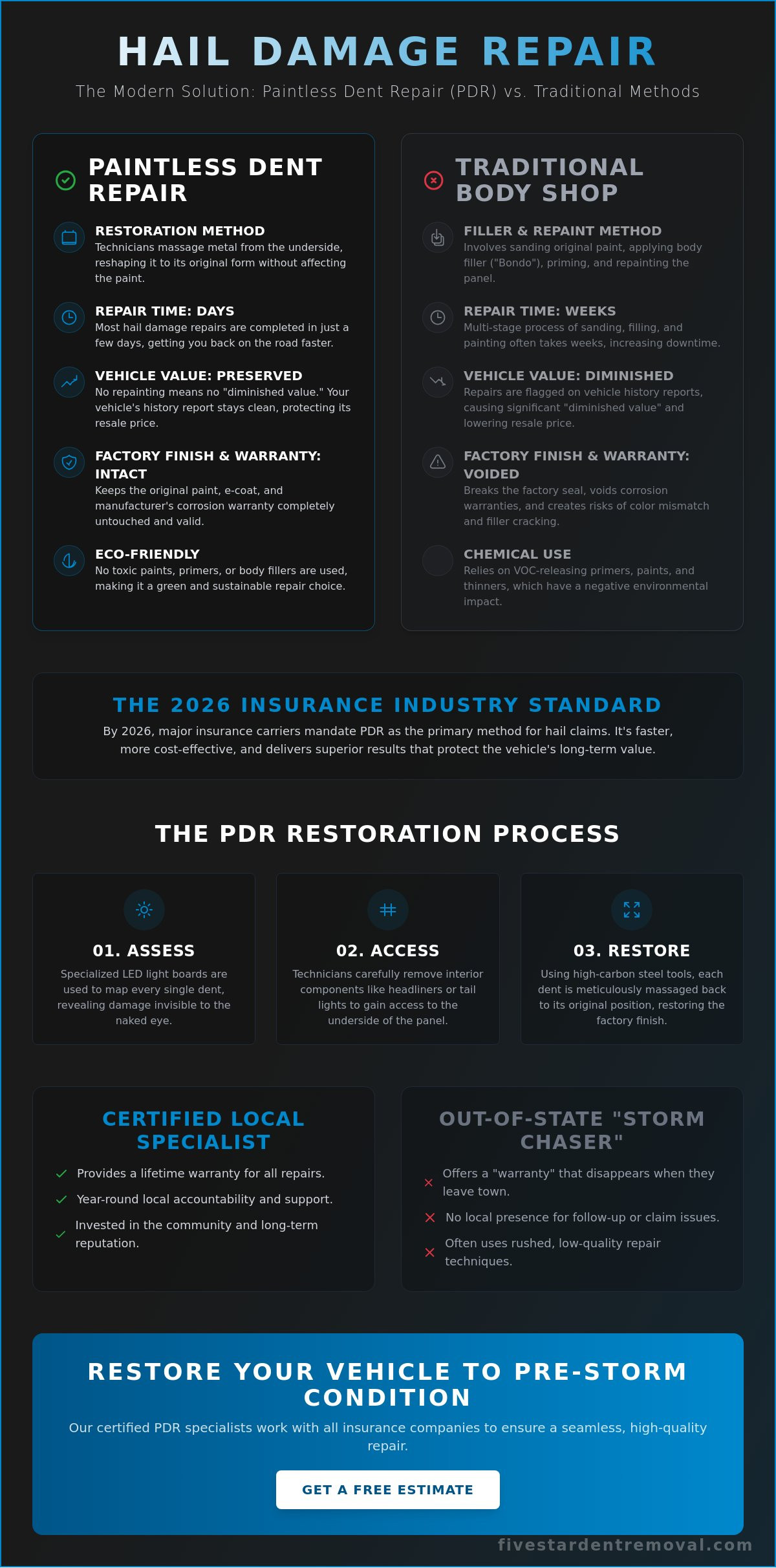
By 2026, the insurance industry has largely mandated PDR for hail damage as the first-line repair method for comprehensive claims. It’s faster and more cost-effective than traditional resprays. In North Atlanta, our specialists have adapted to the increasing use of aluminum panels in newer trucks and SUVs. Aluminum is less pliable than steel and requires more heat and technical precision. Because PDR doesn’t involve “fill and paint” tactics, it’s the only way to ensure your car doesn’t suffer from diminished value after a storm hits.
PDR vs. Traditional Body Shops: Which is Best for Hail?
Choosing between a collision center and a specialist for PDR for hail damage comes down to one critical factor: the factory seal. Your vehicle’s original paint is applied in a controlled environment using high-heat curing processes that a standard body shop cannot replicate. When a shop sands a panel to apply filler and new paint, they break this protective barrier. This often leads to issues with color matching, especially on modern tri-coat or pearl finishes. PDR avoids this entirely by keeping the original paint untouched.
Preserving the Factory Paint Warranty
Repainting even a single panel can void your manufacturer’s corrosion warranty. Most modern warranties are contingent on the factory e-coat remaining intact. Because PDR technicians work from the inside out, the exterior finish stays sealed against the elements. This ensures 100% color consistency across the entire vehicle. It is nearly impossible to achieve this level of perfection when blending paint across multiple panels in a traditional shop environment.
PDR is also the “green” choice for North Atlanta owners. It eliminates the need for toxic primers, paints, and thinners that traditional shops rely on. It also protects the structural integrity of your car. Body fillers, often called “Bondo,” can shrink or crack over time as the metal expands and contracts in the Georgia heat. PDR maintains the metal’s original strength and flexibility. It’s also significantly faster. Most PDR projects are completed in days, while traditional resprays often take weeks of shop time. Knowing how to choose a reputable repair shop helps you find specialists who prioritize these technical benefits over quick, low-quality fixes.
Cost and Value Retention Analysis
Traditional “grind and fill” repairs are often recorded as major body work on vehicle history reports. This triggers a “diminished value” status, which can slash your car’s resale price by thousands of dollars. A professional PDR for hail damage repair typically results in a cleaner history report because no panels were replaced or repainted. The vehicle remains in its original factory state.
When you evaluate the cost of paintless dent repair, remember that you aren’t just paying for the fix. You are paying to protect your vehicle’s long-term equity. Before committing to any repair, reviewing a detailed hail damage repair cost estimate helps you understand exactly how specialists calculate pricing and what your insurance claim should realistically cover. Preserving the original finish is the most effective way to ensure your car retains its maximum value when it’s time to trade or sell. If you want to see if your damage qualifies for this superior method, you can request a professional assessment from a local specialist who understands the nuances of hail restoration.
The Technical Process: How Specialists Restore Hail Damage
Restoring a vehicle after a severe storm requires more than just pushing on metal. It’s a methodical, five-step process that demands technical precision and specialized equipment. Technicians don’t simply “pop” dents back into place; they use a refined sequence to ensure the metal returns to its factory-set memory without stress fractures or paint damage. This disciplined approach is what makes PDR for hail damage the most reliable restoration method available in 2026.
The restoration begins with a meticulous surface decontamination. Every speck of Georgia road grime or pollen must be removed so the technician can see the true profile of each impact. Once the surface is clean, the process moves through these critical stages:
- Access: Specialists carefully remove interior components like headliners, hood insulation, or tail lights to reach the underside of the damaged panels.
- Mapping: Using high-intensity LED reflection boards, the technician maps the “highs” and “lows” of every dent. The light creates a topographical map on the paint, revealing the exact center and depth of the impact.
- Manipulation: Technicians use stainless steel hail rods to apply measured pressure from behind the panel. This “massaging” action slowly coaxes the metal back to its original flat state.
- Quality Control: The final step involves a multi-angle inspection under varied lighting to ensure the reflection is perfectly straight across every repaired surface.
Advanced Tools of the PDR Trade
The 2026 standard for hail restoration involves a sophisticated toolkit. Specialists use high-carbon steel rods with interchangeable tips, allowing them to adjust for different metal gauges and panel thicknesses. For “closed” panels where underside access is blocked, such as roof rails or door pillars, we use glue pulling techniques. This involves adhering specialized tabs to the exterior and using a slide hammer to lift the depression. Modern shops also utilize thermal expansion tools to stabilize complex dents in aluminum panels, preventing the metal from over-stretching during the repair.
The Skill of the Technician
Technical tools are only as effective as the person wielding them. PDR is a high-level art form that requires years of hand-eye coordination training to master. A technician must be able to “read” the reflection of the light board with microscopic accuracy. Even a fraction of a millimeter of over-pressure can ruin the finish. This level of expertise is especially critical for crease dent repair, where the metal has been sharply folded by high-velocity hail. When you trust a specialist with PDR for hail damage, you’re investing in a craftsman who understands how to manipulate metal without compromising its structural integrity.
Navigating the Hail Damage Insurance Claim
Filing an insurance claim after a storm shouldn’t be a source of stress. Hail damage falls under your comprehensive coverage, which is designed for “Acts of Nature.” Because these events are outside of your control, insurance companies generally don’t raise your rates for filing a claim. This makes PDR for hail damage a financially sound decision. You get to restore your vehicle’s value without the fear of a long-term premium hike.
You’ll likely encounter the “Adjuster vs. Technician” gap during this process. Insurance adjusters often inspect vehicles in driveways or parking lots without specialized lighting. They might count 40 dents when a professional technician finds 120. This is why initial insurance estimates are almost always too low. A professional PDR shop handles the supplemental claim process for you. We document every single impact and negotiate directly with your carrier. This ensures the insurance check covers the actual cost of a high-quality restoration.
Remember your “Right to Choose.” Georgia law protects your right to select any repair facility you trust. You aren’t required to use the insurance company’s “preferred” or “contract” shops. These shops often have agreements to prioritize speed and cost-savings over technical perfection. Choosing an independent regional specialist ensures the focus stays on your vehicle’s structural integrity and factory finish.
Step-by-Step Insurance Filing
Start by documenting the damage immediately after a North Atlanta storm. Take photos of your vehicle in the shade or under a carport. This makes the surface depressions easier to see on camera. Once you file the claim and obtain your claim number, the heavy lifting is done. We take over from there to manage the technical inspections. For a more detailed walkthrough, follow our hail damage insurance claim process guide.
Avoiding the Deductible Trap
Be wary of shops that offer to “waive” your deductible. This is often a red flag for insurance fraud or a sign that the technician will cut corners to save on labor costs. High-quality metal manipulation takes time and precision. If a shop isn’t charging for the deductible, they’re likely rushing the repair or skipping critical quality control steps. Transparency in billing is a hallmark of Five Star Dent Removal. We provide honest estimates that reflect the true work required to restore your car. If you’re ready to start your claim with a team that puts your vehicle first, contact Five Star Dent Removal today for a professional assessment.
Local Specialists vs. Storm Chasers: Protecting Your Investment
After a major Georgia hailstorm, you’ll likely notice temporary tents appearing in parking lots and vacant lots. These “storm chasers” are out-of-state crews that follow weather patterns across the country. While they often promise quick turnarounds, they lack the local roots required for long-term accountability. Choosing PDR for hail damage from a transient company puts your vehicle’s warranty and structural integrity at risk. When the storm season ends, these crews move on, leaving you with no recourse if issues arise later.
The warranty risk is a significant concern for North Atlanta vehicle owners. Precision repairs involve more than just the exterior surface. Technicians must remove and reinstall complex interior components like headliners, airbags, and sensor arrays. If a trim piece rattles or an electronic component malfunctions six months after the repair, a storm chaser is nowhere to be found. Local specialists maintain permanent facilities in the community. We’re here to stand behind our craftsmanship long after the clouds have cleared.
Vetting your repair partner requires looking for industry-standard credentials. Vale Training certification is a primary trust marker in the PDR industry. This certification involves a timed, hands-on evaluation of a technician’s ability to restore metal without damaging the paint. It separates seasoned professionals from those who might use aggressive, “quick-fix” tactics that compromise your factory finish. Always ask for proof of certification before handing over your keys.
Checklist for Choosing a Hail Repair Partner
- Permanent Location: Does the shop have a physical, year-round address in the Atlanta area?
- Written Warranty: Do they provide a written lifetime warranty on their craftsmanship?
- Proven Reputation: Are they a recognized name for paintless dent repair Alpharetta?
- Insurance Handling: Do they have a clear process for managing supplemental claims with your carrier?
The Five Star Difference
Five Star Dent Removal is committed to preserving the factory finish of every vehicle we service. Whether you drive a high-end luxury SUV or a reliable daily commuter, our process remains the same: precision, transparency, and technical excellence. We offer both mobile and shop-based options to fit the busy schedules of North Atlanta residents. Our deep roots in the region mean we value our reputation as much as you value your vehicle. Don’t leave your car’s resale value to chance with a temporary tent operation. Schedule your professional hail damage assessment today and experience the reliability of a local specialist.
Restore Your Vehicle’s Value Today
Choosing the right restoration path after a storm determines your vehicle’s long-term resale value and structural health. You now understand why paintless methods are the insurance-preferred standard for 2026. By avoiding the ‘grind and fill’ traps of traditional body shops, you preserve your factory paint warranty and ensure a perfect color match. PDR for hail damage isn’t just a convenience; it’s a strategic investment in your car’s equity.
Five Star Dent Removal brings over 20 years of professional industry experience to every repair. We specialize in luxury vehicle restoration and prioritize factory paint preservation above all else. Our team stands behind every repair with a lifetime warranty on all PDR craftsmanship, providing you with the local accountability you deserve. Don’t let storm damage diminish your vehicle’s worth or your peace of mind.
Get a Free Hail Damage Estimate from Five Star Dent Removal. We’re ready to help you navigate the claim process and get your vehicle back to its pre-storm condition with precision and care.
Frequently Asked Questions
Will PDR for hail damage cause my car’s paint to crack?
Paint cracking is extremely rare when a certified technician performs PDR for hail damage. Modern factory finishes are engineered with high elasticity to withstand temperature fluctuations and minor surface shifts. We use controlled pressure and specialized tools to massage the metal back into place without exceeding the paint’s flex point. If the paint is already chipped from a high-velocity impact, we’ll identify those areas during the initial assessment.
How long does it typically take to repair a hail-damaged car using PDR?
Most hail restoration projects are completed within two to five business days. This timeline depends on the total dent count and the complexity of the panel access required. Traditional body shops often require two to three weeks for the same level of damage because of the drying time needed for fillers and paint. Our process prioritizes efficiency to get you back on the road quickly without compromising quality.
Can PDR fix large hail dents or just small ones?
PDR is effective for both small dimples and larger surface depressions. The limiting factor isn’t usually the size of the dent, but rather the depth and the condition of the paint. If the metal isn’t sharply creased or overstretched, we can successfully restore large areas. We evaluate each impact point to ensure the metal retains its structural integrity and returns to its factory-set memory.
Does my insurance company cover PDR for hail damage?
Comprehensive insurance policies almost always cover paintless restoration for storm damage. It’s the industry’s preferred method because it maintains the vehicle’s original parts and finish. We work directly with your carrier to ensure the estimate reflects the actual work required. Filing a hail claim typically doesn’t impact your insurance premiums since it’s considered an act of nature outside of your control.
What happens if the hail dents are on a plastic bumper or trim?
Paintless restoration is strictly for metal panels like hoods, roofs, and fenders. If your vehicle has damage on a plastic bumper, we utilize specialized bumper repair techniques to restore the surface. Plastic doesn’t have the same “memory” as steel or aluminum, so it requires a different technical approach. We inspect every part of the vehicle to ensure no damage is overlooked during the restoration process.
Can I do PDR for hail damage myself with a kit from the internet?
Internet PDR kits often cause more damage than they fix. Professional restoration requires specialized high-carbon steel tools and years of hand-eye coordination training to master. DIY attempts frequently result in “high spots” or cracked paint that makes professional repair more difficult and expensive. Trusting a specialist ensures the job is done right the first time without risking your vehicle’s resale value.
Is PDR effective on older cars with original paint?
PDR is highly effective on older vehicles as long as the original paint is in good condition. Brittle or oxidized paint on cars older than 20 years may have a higher risk of losing its bond during the manipulation process. We perform a visual inspection to check for paint health before starting. If the finish is healthy and flexible, the metal will respond just as well as a newer model.
Why should I choose a local Alpharetta shop instead of an insurance-recommended ‘tent’?
Choosing a local Alpharetta shop ensures long-term accountability and a valid lifetime warranty on craftsmanship. Insurance-recommended tents are often staffed by out-of-state crews who leave the area once the storm claims subside. If you notice a missed spot or a loose interior clip later, a local business is here to fix it. We value our reputation in the North Atlanta community and prioritize precision over high-volume turnover.