

Georgia ranks as the fifth-highest state for financial impact from hailstorms, with average claim payouts reaching $17,000 in 2025. Walking out to find your vehicle covered in dents is a gut-punch. It’s common to worry about insurance rate hikes or the confusion between comprehensive and collision coverage. Understanding the hail damage insurance claim process is the first step toward a professional resolution that protects your investment.
This guide offers a clear, functional roadmap for your recovery. We’ll show you how to secure the high-quality PDR repairs your car deserves while navigating the paperwork with confidence. You can expect a streamlined path to claim approval and a finished product that preserves your factory paint. We’ll outline how to maximize your benefits, including Georgia’s unique diminished value regulations, to ensure your vehicle returns to its pre-storm condition without surprises beyond your deductible. Our approach is fast, efficient, and precise, moving you through the restoration process with local expertise you can trust.
Key Takeaways
- Take immediate action by moving your vehicle and documenting storm details to simplify your initial report.
- Navigate the hail damage insurance claim process with a structured five-step approach that ensures you receive the proper claim number and adjuster support.
- Verify your comprehensive coverage and deductible amount to eliminate financial surprises before the repair begins.
- Prioritize Paintless Dent Repair (PDR) to maintain your vehicle’s original factory paint and protect its long-term market value.
- Learn the critical markers of a reputable Alpharetta specialist to avoid temporary contractors and ensure local accountability.
Immediate Actions: What to Do Right After the Hail Storm
The storm has passed. Your first priority is preventing secondary damage. Move your vehicle to a garage, carport, or under a sturdy cover as soon as it’s safe. Wind-blown debris or falling limbs often follow hailstorms; you don’t want to complicate your hail damage insurance claim process with additional collision-style damage. Once the car is secure, record the exact date and time of the storm. Insurance representatives cross-reference this information with local meteorological data to validate your claim.
Identify the severity of the storm by measuring the hailstones. Don’t just guess the size. Place a common object like a quarter or a golf ball next to a stone and take a photo. This simple comparison provides the adjuster with a clear scale of the impact force. Understanding Your Policy is vital at this stage, as it helps you identify which coverage applies to weather events. Knowing your coverage type early prevents confusion during the initial filing.
Photographing Auto Hail Damage for Adjusters
Documenting dents is a technical task. Avoid taking photos in direct sunlight; the glare hides the very damage you need to show. Move the vehicle into a garage or a shaded area where reflections are more visible. Instead of shooting the dent straight-on, position your camera at a 45-degree angle. This perspective allows the car’s natural body lines and reflections to “break” over the dent, making the depth and diameter obvious to the adjuster. Ensure your photo set includes the VIN, usually found on the dashboard or driver-side door jamb, and your license plate to verify the vehicle’s identity.
The “Act of Nature” Rule in Georgia
Georgia vehicle owners benefit from specific legal protections. Hail damage is legally classified as an “Act of Nature.” Because these events are outside of your control, filing a claim typically won’t result in an individual premium hike. This differs significantly from at-fault collision claims. Georgia ranks 5th in the nation for financial impact from hailstorms, with total property damage amounting to $139 million annually. In 2025 alone, State Farm paid nearly $110 million for hail damage claims in Georgia. Because of this high volume, the hail damage insurance claim process is highly standardized. Most policies in the North Atlanta area require you to file within six months to one year of the storm date. Acting quickly ensures you stay within these windows and secures your place in line for professional restoration.
Understanding Your Policy: Comprehensive vs. Collision
Confirming your coverage type is the first hurdle in the hail damage insurance claim process. Standard liability insurance in Georgia only covers damage you cause to others. To fix your own vehicle after a storm, you must have comprehensive coverage. This specific policy type protects against “other than collision” events, including weather, fire, and theft. It’s helpful to review the industry definitions of Comprehensive vs. Collision to see why hail is never filed as a collision claim. Because hail is an environmental event, it doesn’t carry the same “at-fault” stigma as a fender bender.
Check your policy for “Rental Car Reimbursement” before you drop off your keys. While Paintless Dent Repair is significantly faster than traditional bodywork, your car will still be in the shop for several days. If your policy includes this rider, the insurance company covers the cost of a loaner. If it doesn’t, you’ll need to budget for transportation. A professional hail repair specialist can help you review your estimate to ensure the timeline matches your rental coverage.
The Role of the Deductible
Your deductible is the fixed amount you pay before insurance covers the rest. According to the CCC Intelligent Solutions 2026 Crash Course Report, 26% of U.S. drivers now carry a deductible of $1,000 or more to lower their monthly premiums. The insurance company doesn’t send you a bill for this amount; they simply subtract it from the total repair payout. If your repair estimate is $4,000 and your deductible is $1,000, the insurer issues a check for $3,000. Be cautious of shops offering to “waive” your deductible. This practice often involves inflating the estimate or cutting corners on quality to cover the gap, which can compromise the integrity of your repair. For a transparent breakdown of what professional restoration actually costs, our hail damage repair cost estimate guide explains the specific factors that influence professional quotes so you can approach your claim with total confidence.
Total Loss Thresholds for Hail Damage
Georgia follows a “75% rule” for totaling vehicles. If the cost of repairs exceeds 75% of the car’s current market value, the insurer may declare it a total loss. Traditional body shops often trigger this threshold because they insist on replacing entire roof panels and repainting the vehicle, which is labor-intensive and expensive. Paintless Dent Repair (PDR) is a pragmatic alternative that often keeps repair costs well below the total loss limit. By massaging the metal back to its original shape without replacing panels, PDR preserves the factory finish and keeps your vehicle on the road rather than in a salvage yard.
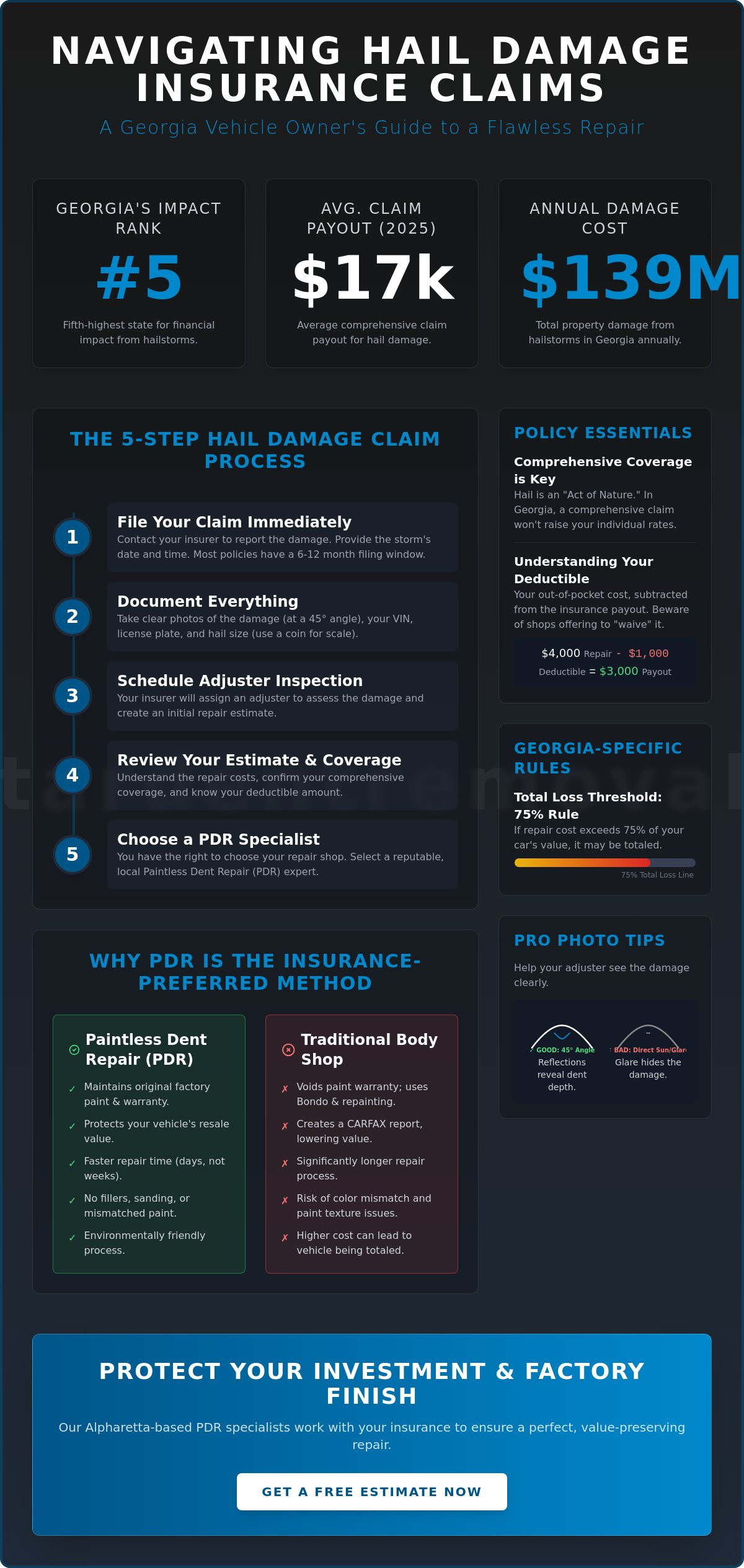
The 5-Step Hail Damage Insurance Claim Process
Restoring your vehicle starts with a structured workflow. Following a precise hail damage insurance claim process ensures no damage is overlooked and your out-of-pocket costs remain limited to your deductible. Most modern insurers have streamlined these steps to handle the high volume of claims following North Atlanta storms. Efficiency is the priority. Use this five-step sequence to move from initial impact to a dent-free finish.
- Step 1: Contact your insurance provider. Initiate the claim immediately through their mobile app or claims hotline. Provide the storm date and the specific location where the damage occurred.
- Step 2: Secure your claim number. This unique ID is the master key for your entire repair. Your insurer will also assign an adjuster to oversee the file and approve the repair costs.
- Step 3: Schedule the inspection. You’ll typically have the choice between an at-home visit, a drive-in claims center, or an inspection at your chosen repair facility.
- Step 4: Review the initial estimate. The adjuster will provide a line-item breakdown of the damage. Compare this carefully against the physical dents you documented earlier.
- Step 5: Select a specialized PDR shop. Choose a local expert to perform the restoration. They’ll work directly with your adjuster to finalize the payment details.
Filing the Initial Report
Precision matters during your first call. Provide the exact street address or zip code where the hail hit; insurers use this to confirm the claim against local weather records. If your provider offers a mobile app, use it to upload your high-contrast photos. This often triggers a faster response than a standard phone call. Keep a dedicated log of every interaction. Write down the names of representatives, their direct extensions, and the dates of every conversation. This documentation prevents communication gaps as your file moves through the hail damage insurance claim process.
Managing the Adjuster Meeting
The adjuster’s goal is to provide an accurate baseline, but they often miss smaller impacts in standard lighting. Professional technicians use specialized “hail lights” to cast a specific glow across the panels, revealing every micro-dent. Having a PDR expert present during the inspection is highly beneficial. They speak the adjuster’s language and ensure the initial estimate reflects the true scope of work. If the adjuster’s quote is too low, your shop will request a “supplement.” This is a standard industry practice where the shop submits additional evidence to the insurer to cover the full cost of a high-quality restoration. You can learn more about the technical nuances of the hail damage claim process to prepare for these interactions.
Why PDR is the Standard for Insurance-Paid Repairs
Insurance providers prioritize Paintless Dent Repair (PDR) because it’s the most effective way to restore a vehicle’s surface. This method is the preferred industry standard for a simple reason: it works with the car’s original engineering rather than against it. By using specialized tools to massage the metal back to its factory shape, technicians eliminate the need for harsh chemicals or replacement panels. This approach is a cornerstone of a successful hail damage insurance claim process, ensuring your vehicle retains its structural and aesthetic integrity.
Preserving the factory paint is the most significant benefit of PDR. Your car’s original finish is applied in a controlled environment and baked at high temperatures for maximum durability. Once that paint is sanded or covered with filler, you lose that superior protection. PDR keeps the factory seal intact, which prevents future rust and ensures the color remains a perfect match. Beyond the physical benefits, PDR is an environmentally friendly choice. The process requires no toxic paints, primers, or thinners, making it the cleanest restoration method available today. For a comprehensive look at how PDR for hail damage meets the latest 2026 industry standards and protects your vehicle’s value, our complete guide covers every technical detail you need to know.
- Resale Value: Vehicles repaired with PDR maintain a cleaner Carfax history compared to those receiving major collision work.
- Speed: Restoration often takes only a few days, getting you back on the road much faster than traditional shops.
- Quality: The repair is permanent. The dents won’t “pop back” or shrink over time.
PDR vs. Traditional Body Shops
Traditional body shops often rely on the “bondo and paint” method. This involves grinding down your factory finish, filling the dents with plastic putty, and respraying the panels. This labor-intensive process is expensive and can lead to mismatched textures or colors. Insurers prefer PDR because it offers better results at a more efficient price point. If you’re curious about the financial breakdown, you can review our guide on how much does paintless dent repair cost. Choosing PDR means choosing a repair that is invisible to the naked eye and future buyers alike.
The Supplement Process
Initial insurance estimates are frequently lower than the actual cost of repair. Adjusters often work in parking lots or driveways where poor lighting makes it impossible to see every small impact. Don’t be alarmed if the first check you receive seems “low-ball.” This is a standard part of the hail damage insurance claim process. Once your car is in our specialized facility under high-intensity hail lights, we’ll identify every missed dent. We then submit a “supplement” directly to your insurer. This document provides the photographic evidence needed to approve the additional funds. We handle the negotiation and paperwork, so you don’t have to worry about the gap in coverage. If you’re ready to start your restoration, contact our Alpharetta PDR specialists for a professional assessment.
Choosing an Alpharetta Hail Repair Specialist
Selecting the right technician is the final and most critical stage of the hail damage insurance claim process. North Atlanta is a frequent target for “storm chasers.” These are out-of-state companies that set up temporary tents in parking lots after a major hailstorm. While they promise speed, they often lack the specialized tools required for complex body line and crease repairs. Once the storm season ends, they disappear. Choosing a specialist with a permanent Alpharetta presence ensures you have local accountability and a point of contact for your lifetime warranty. You need a partner who understands the local climate and the specific expectations of Georgia drivers.
Technical expertise is non-negotiable. Look for a shop that demonstrates a mastery of Paintless Dent Repair on various metal types, including aluminum panels common in modern luxury vehicles. A professional restoration should be invisible. If a shop cannot explain how they handle deep creases or impacts on body lines, they aren’t the right fit for your vehicle. High-quality PDR preserves your factory finish, but only when executed by seasoned specialists who value precision over volume.
Your Right to Choose a Repair Shop
Georgia law is clear: you have the legal right to choose any repair facility you prefer. Your insurance company might suggest a “preferred shop” or a “Direct Repair Program” (DRP). These shops often have contracts that prioritize the insurer’s cost-savings over the absolute quality of your restoration. An independent specialist focuses solely on the vehicle owner’s best interest. Before committing, ask potential shops about their experience with your specific vehicle brand. A shop that understands the unique metallurgy of your car will provide a more durable and aesthetically perfect result.
The Five Star Dent Removal Difference
Five Star Dent Removal has served the Alpharetta and Roswell communities for over 20 years. We understand the nuances of the hail damage insurance claim process better than any temporary contractor. Our team specializes in high-value PDR that restores your vehicle to its pre-storm condition without the need for fillers or paint. We offer a “concierge” claim service, meaning we manage the communication with your insurance adjuster from start to finish. We ensure all supplements are filed correctly so you pay nothing beyond your deductible. Our reputation is built on honesty, efficiency, and a service-first attitude.
For more details on our specialized methods, visit our page on hail damage repair Alpharetta. Don’t file your claim blindly or settle for a “storm chaser” repair. Contact us today for a professional pre-claim inspection to document the full scope of your damage and secure the high-quality restoration your vehicle deserves.
Restore Your Vehicle’s Value with Expert Precision
Navigating the hail damage insurance claim process doesn’t have to be a source of stress. By documenting damage early and understanding your comprehensive coverage, you take control of your vehicle’s recovery. Remember that Paintless Dent Repair remains the gold standard for maintaining your factory finish and resale value. Avoid the temporary solutions offered by out-of-state contractors; local accountability is the only way to ensure your car receives the detailed attention it deserves.
Five Star Dent Removal brings over 20 years of PDR expertise to every restoration. We proudly serve Alpharetta, Roswell, and the greater North Atlanta area with a commitment to quality that includes a lifetime warranty on all repairs. We handle the technical supplements and adjuster communications so you can focus on getting back to your routine. Get a Professional Hail Damage Assessment in Alpharetta today. Your car’s factory-perfect finish is just a few steps away.
Frequently Asked Questions
Will filing a hail damage claim raise my insurance rates in Georgia?
No, your individual insurance premiums typically won’t increase due to a hail claim. Georgia law classifies hail as an “Act of Nature,” meaning the damage was outside of your control and you aren’t at fault. Because these claims fall under your comprehensive coverage rather than collision, insurers generally don’t penalize you with a rate hike for weather related events.
How long do I have to file a hail damage claim after a storm?
Most insurance policies in Georgia require you to file a claim within six months to one year of the storm date. It’s vital to check your specific policy language to confirm your deadline. Acting quickly is pragmatic; it ensures the damage is clearly linked to a specific meteorological event and hasn’t been complicated by subsequent wear or secondary accidents.
Do I have to use the body shop my insurance company recommended?
You have the legal right to choose any repair facility in Georgia. While insurance companies often suggest “preferred shops” to streamline their own costs, you aren’t obligated to use them. Selecting an independent Alpharetta specialist allows you to prioritize high quality Paintless Dent Repair and factory paint preservation over the insurer’s preferred bottom line.
What if the insurance check is less than the repair estimate?
This is a standard part of the hail damage insurance claim process and is resolved through a supplement. Initial checks are often baseline estimates based on visible damage in poor lighting. A professional PDR shop will use specialized lights to identify every impact and submit a supplemental request to your insurer to cover the full cost of the restoration.
Can I get my car fixed with PDR if the paint is cracked?
Paintless Dent Repair isn’t an option if the vehicle’s paint is already cracked or bubbling. PDR relies on the elasticity of your factory finish to massage the metal back into place. If the hail was severe enough to break the paint seal, traditional repair methods are required to prevent moisture from reaching the metal and causing rust over time.
What happens if my car is totaled due to hail damage?
Georgia insurers typically declare a vehicle a total loss if repair costs exceed 75% of its actual cash value. If your car reaches this threshold, the insurance company will pay you the fair market value minus your deductible. However, because PDR is more cost effective than panel replacement, it often keeps repair costs below this “totaled” limit.
Is it possible to repair hail damage without filing an insurance claim?
Yes, you can choose to pay for repairs out of pocket to keep the incident off your vehicle’s history report. This is a common choice for owners with high deductibles or very minor damage. Before deciding, reviewing a detailed hail damage repair cost estimate helps you compare out-of-pocket PDR pricing against your deductible so you can make the most informed financial decision. Paying directly allows you to bypass the administrative steps of the hail damage insurance claim process and move straight to the restoration of your vehicle.
How long does the typical hail repair process take with PDR?
Most Paintless Dent Repair restorations are completed within 2 to 5 business days. This is significantly faster than traditional body shops, which often require weeks for parts delivery and paint curing. The exact timeline depends on the number of dents and the current volume of vehicles at the shop following a major North Atlanta storm.