

What if the most expensive part of your hail damage repair isn’t the repair itself, but the permanent loss of your vehicle’s factory value? Most drivers in North Atlanta dread the aftermath of a sudden storm. You’re likely staring at a hood full of dimples and wondering if your insurance rates will skyrocket or if a body shop will use heavy fillers. This guide provides a transparent 2026 hail damage repair cost estimate framework so you can approach your claim with total confidence. You’ll learn how specialists calculate pricing using a standardized matrix that protects your car’s original finish.
We understand that dealing with insurance and technical jargon feels overwhelming. Paintless Dent Repair (PDR) is the industry standard for a reason. It’s faster and more cost-effective than traditional bodywork. We’ll break down the specific factors that influence professional quotes, explain why hail claims are typically no-fault, and show you how to secure an accurate local estimate. Our goal is to move you from frustration to a restored vehicle with zero surprises. Get the facts you need to make an informed decision for your vehicle today.
Key Takeaways
- Learn why a professional hail damage repair cost estimate relies on the standardized “Hail Matrix” rather than unreliable ballpark guesses.
- Discover how vehicle materials like aluminum and specific panel locations influence the technical complexity and precision required for your repair.
- Understand the insurance supplement process to ensure every hidden dent is documented and covered under your comprehensive policy.
- Identify why Paintless Dent Repair (PDR) remains the industry-preferred method for preserving your vehicle’s original factory finish and resale value.
- See how Five Star Dent Removal utilizes master-level technicians and specialized lighting to deliver precision results for drivers in Alpharetta and North Atlanta.
Understanding Your Hail Damage Repair Cost Estimate in 2026
A professional hail damage repair cost estimate is a precision calculation. It isn’t a ballpark figure scribbled on a notepad or a guess made over the phone. Instead, it’s a multi-factor analysis that weighs dent density, depth, and the specific metallurgy of your vehicle. Relying on a phone quote for complex hail damage is a significant mistake for any North Atlanta driver. Without seeing the car in person, a technician cannot account for the way light wraps around a panel or identify how many microscopic impacts are hiding in plain sight.
Modern 2026 vehicles often feature advanced aluminum alloys and high-strength steels. These materials have different memory characteristics than older automotive metals. Aluminum requires specialized heat application and specific tools to manipulate safely without cracking the paint. If an estimate ignores these material science factors, the final bill will likely include unexpected supplements that delay your repair. A professional inspection ensures that every variable is accounted for before the first tool touches your car.
Visual Inspection vs. Digital Scanning
Valid estimates require high-intensity LED lights to reveal the true extent of the storm’s impact. What looks like five small dings in the driveway often turns into fifty distinct impacts under a professional light board. These lights create a reflection that allows a technician to see every distortion in the clear coat and metal. Specialized high-contrast lighting reveals microscopic paint fractures that are invisible to the naked eye. This level of detail ensures your insurance claim is filed accurately the first time. It bridges the gap between what you see in the sun and what a master technician sees in the shop environment.
The Shift Toward Paintless Restoration
The automotive industry has shifted decisively toward restoration over replacement. Paintless Dent Repair (PDR) is now the gold standard for insurance providers and luxury car owners alike. The primary financial benefit is simple; you keep your original factory paint intact. Once a vehicle is sanded and repainted at a traditional body shop, its resale value drops. By choosing PDR for hail damage, you preserve the long-term equity of your car. This method avoids the risk of mismatched paint colors or “orange peel” textures. It’s a cleaner, faster, and more precise way to restore your vehicle to its pre-storm condition without the complications of traditional bodywork.
The Industry Standard: How PDR Technicians Calculate Hail Estimates
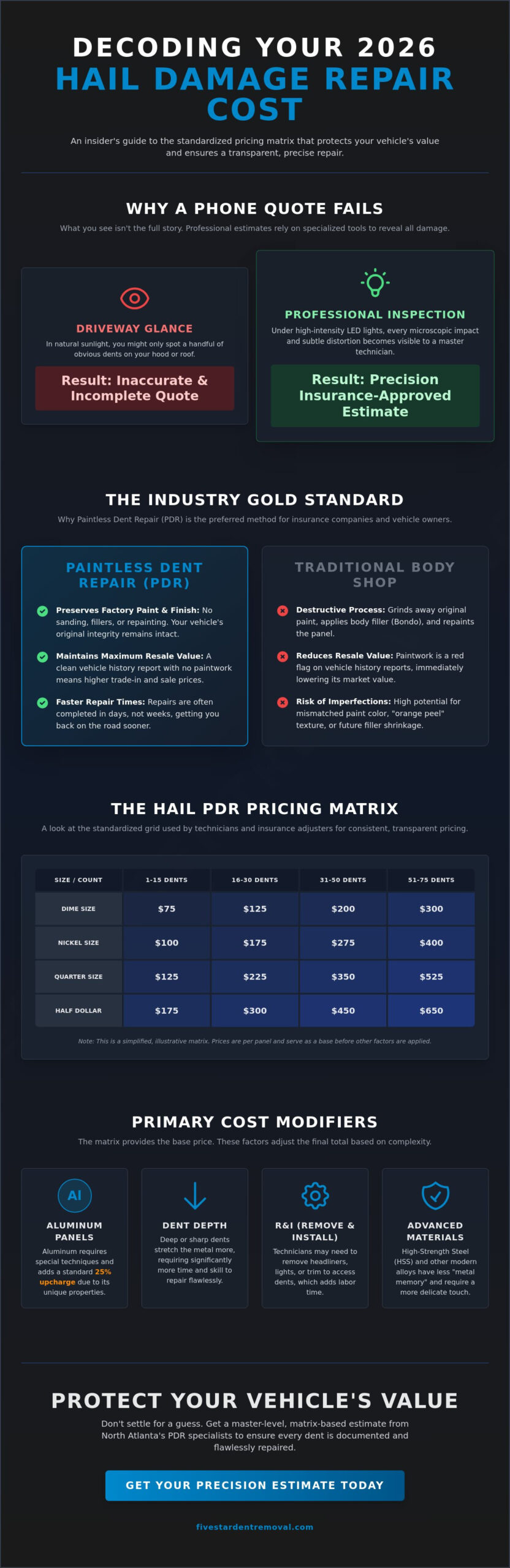
Professional estimates aren’t arbitrary. They rely on a standardized system called the “Hail Matrix.” This grid-based tool ensures that every hail damage repair cost estimate remains transparent and consistent across the industry. It serves as a common language between technicians and insurance adjusters. By using a pre-defined matrix, shops avoid the “black box” pricing that causes consumer distrust. It prioritizes precision over guesswork.
Technicians categorize damage using two primary variables: dent size and dent count per panel. Sizes are typically compared to common currency. You’ll see classifications for dime, nickel, quarter, and half-dollar sized hits. A panel with 15 quarter-sized dents often requires more labor than one with 30 dime-sized dings. This is because larger impacts involve more displaced metal and a higher risk of paint stress. The matrix provides a base price that scales as the “hit count” increases across panels like the hood, roof, and trunk.
Decoding the Pricing Matrix
During a professional inspection, a technician may place a physical or digital grid over your vehicle’s panels. This allows for an accurate count of hits within a specific square footage. It’s a common surprise that 50 small dents can sometimes cost more than five large ones. Each individual dent requires a unique set of micro-pushes and finishing strokes. Depth is the silent driver of labor time. Deeper dents challenge the “metal memory” of the panel, requiring a master-level touch to restore the surface without causing high spots. If you carry comprehensive insurance, your adjuster will utilize this same matrix logic to verify the shop’s quote. It’s a system designed to protect the consumer from inflated costs while ensuring the technician is compensated for the actual work performed.
Upcharges for Complex Damage
Not all areas of a vehicle are equally accessible. Roof rails and sharp body lines often require specialized tool access and higher technical skill. These areas frequently feature double-walled steel or structural bracing that complicates the repair. You may also encounter a “Deep Dent” surcharge if the hail pushed the metal past its elastic limit. This requires advanced “shrinking” techniques to prevent the metal from “oil-canning” or popping. In 2026, we also account for Advanced Driver Assistance Systems (ADAS). If a hail repair requires removing a headliner or side mirrors, sensors may need recalibration to keep your safety features active. For a precise breakdown of how these factors apply to your car, you can request a professional assessment from a specialist at Five Star Dent Removal.
Primary Factors That Drive Your Total Repair Quote
While the Hail Matrix provides the mathematical foundation, physical variables determine the final complexity of the job. Your hail damage repair cost estimate isn’t just about counting dents. It’s about how those dents interact with your car’s specific engineering. Technicians must evaluate the metallurgy, accessibility, and finish of every impacted panel before a final price is set. This stage of the inspection separates a professional restoration from a quick fix.
Steel has a natural “memory” that technicians use to their advantage. Aluminum is different. It’s lighter but much stiffer. This requires more heat, specialized tools, and a slower pace to massage the metal back into its original form. Panel location matters just as much. A hood is often wide open once the insulation is removed. A roof rail or a door panel with internal safety bracing is a fortress. We also prioritize paint integrity. If the storm was severe enough to crack the clear coat, the repair shifts from restoration to traditional bodywork. PDR relies on the paint being flexible. If that bond is broken, the estimate must account for paint shop labor rather than specialized massage techniques.
Aluminum vs. Steel Panels
In 2026, many luxury and electric vehicles utilize aluminum to improve efficiency. These panels often carry a 25-50% surcharge in estimates because they are notoriously difficult to manipulate without damaging the paint. Aluminum doesn’t “flow” like steel; it resists movement until it reaches a breaking point. Modern EV construction, specifically for brands like Tesla or Rivian, often includes unique structural reinforcements that limit tool access. Understanding how insurance adjusters calculate estimates for these high-tech materials is vital for a transparent quote. It ensures the technician has the time required to perform a master-level repair.
R&I: The Hidden Cost Factor
R&I stands for “Remove and Install.” It’s the labor required to reach the back of the damaged metal. This process might involve dropping a headliner, removing tail lights, or stripping hood insulation. Complex sunroof assemblies and side-curtain airbags add significant labor hours to the total. To get a perfect result, we often have to disassemble parts of the interior.
- Headliners: Required for roof repairs; involves disconnecting overhead consoles and pillar trim.
- Hood Liners: Removed to access the underside of the hood panel.
- Tail Lights & Trim: Often pulled to reach quarter panels or trunk lids.
Precision is mandatory during this stage. Professional re-installation ensures you don’t face wind whistles, water leaks, or rattling trim down the road. It’s the difference between a car that looks fixed and a car that feels like new. When reviewing your quote, look for these specific line items to understand exactly where the labor is being allocated.
Insurance Claims vs. Out-of-Pocket: Managing Your Deductible
Hail damage is legally classified as an “Act of Nature.” In Georgia, insurance companies process these under your comprehensive coverage rather than your collision policy. This is a vital distinction for North Atlanta drivers. Because you aren’t at fault for the weather, filing a claim for hail damage usually won’t result in a premium increase. Understanding this allows you to prioritize the structural and aesthetic restoration of your vehicle without fearing long-term insurance penalties. You’re responsible only for your deductible, while the carrier covers the remainder of the professional hail damage repair cost estimate.
Deciding whether to pay out-of-pocket depends on the severity of the storm. If your car has only two or three minor dings, the cost might be lower than your deductible. In those cases, keeping the claim off your vehicle history report makes financial sense. However, if the damage is widespread across multiple panels, navigating the hail damage insurance claim process is the most pragmatic path. It ensures your car’s resale value is protected through master-level PDR restoration.
Working with Your Insurance Adjuster
Don’t be surprised if the initial check from your insurance company is significantly lower than the final repair bill. Adjusters often perform inspections in parking lots or driveways where ambient light hides 40% to 60% of the damage. This is why the “supplement” process exists. Once your vehicle is under our specialized shop lighting, we document every missed impact. Five Star Dent Removal works directly with your insurance carrier to submit these findings and secure approval for the full repair cost. To help the process, take clear photos of the damage immediately after the storm and before your adjuster appointment. This creates a baseline for your claim.
The ‘Totaled’ Vehicle Threshold
Insurance companies typically declare a vehicle “totaled” when repair costs exceed 70% to 80% of its actual cash value. In the 2026 market, used car valuations remain high, but so do the costs of traditional body shop parts. Paintless Dent Repair often serves as a “save” for vehicles on the brink of being totaled. Because PDR eliminates the need for expensive replacement panels and resprays, we can often restore a car for thousands less than a collision center. This prevents your vehicle from being branded with a salvage title and keeps your daily driver on the road. If you’re unsure if your car is worth fixing, contact Five Star Dent Removal for a professional second opinion before you settle with the insurance company.
Get a Precision Hail Estimate in Alpharetta with Five Star Dent Removal
Experience matters when your vehicle’s value is on the line. Five Star Dent Removal has spent 20 years serving the Alpharetta, Roswell, and North Atlanta communities. We don’t just fix dents. We restore your vehicle’s factory integrity. Our team consists of master-level PDR technicians who understand the specific storm patterns and insurance climate of our region. While national chains offer generic service, we provide the local expertise required to navigate Georgia’s specific claim requirements. We’re your neighbors, and we take pride in every restoration that leaves our shop.
Choosing between a mobile or shop estimate depends on your schedule and the severity of the damage. For light dings, our mobile units provide unmatched convenience at your home or office. For comprehensive storm damage, our local shop offers the controlled environment needed for a precision hail damage repair cost estimate. We take the burden of insurance paperwork off your plate entirely. From the initial inspection to the final supplement approval, we manage the communication with your carrier. You get a restored vehicle without the stress of playing middleman with an adjuster.
The Five Star Estimation Process
Accuracy begins with the right environment. We utilize a clean-room inspection process equipped with professional-grade light boards to identify every impact. This data is compiled into a detailed digital report that serves as the foundation for your claim. Transparency is our standard. You won’t find surprise fees once the R&I process begins because we account for every panel and brace during the initial look. We possess deep expertise in luxury car dent repair in Alpharetta. High-end finishes and advanced alloys receive the delicate, expert touch they require to maintain their original factory status.
Scheduling Your Local Inspection
Our specialists are ready to assist residents in Cumming, Buckhead, and Dunwoody. When you arrive for your appointment, please bring your insurance information and your claim number if you’ve already started the process. This allows our team to sync our digital reporting directly with your adjuster’s system for faster approval. We focus on efficiency and precision to get you back on the road as quickly as possible. Don’t let storm damage devalue your investment or complicate your life. Schedule your professional hail damage assessment today and experience the Five Star difference for yourself.
Restore Your Vehicle with North Atlanta’s PDR Specialists
Navigating the aftermath of a storm doesn’t have to be a guessing game. You now understand that a professional hail damage repair cost estimate is a data-driven calculation that prioritizes your car’s factory finish. By choosing Paintless Dent Repair, you avoid the invasive sanding and repainting of traditional body shops. You also know that your comprehensive insurance is designed to handle these exact scenarios without penalizing your rates. This knowledge puts you in control of your vehicle’s restoration and long-term value.
Five Star Dent Removal brings 20+ years of PDR experience to every restoration. We are specialists in North Atlanta storm restoration and serve as your dedicated insurance claim assistance experts. Our team ensures every dent is documented and every supplement is approved by your carrier. Don’t let hidden damage diminish your vehicle’s resale value. Get Your Free Professional Hail Estimate Now and let our master technicians return your car to its pre-storm condition. We look forward to getting you back on the road with a flawless finish.
Frequently Asked Questions
Will a hail damage claim make my car insurance rates go up?
No, filing a hail claim generally won’t increase your premiums. Insurance companies categorize hail as a comprehensive claim because it’s an “Act of Nature” beyond your control. Unlike a collision where you’re at fault, weather-related damage doesn’t reflect your driving habits or risk level. You can restore your vehicle’s value without worrying about a surcharge on your monthly bill.
How long does it take to get a hail damage repair estimate?
A professional inspection typically takes 30 to 45 minutes to complete. This timeframe allows our technicians to clean the panels and use specialized LED light boards to identify every impact. We don’t rush this process because an overlooked dent can lead to claim delays later. You’ll leave with a detailed digital report ready for your insurance provider.
Can I get an estimate from a photo I take on my phone?
No, photos are insufficient for a valid hail damage repair cost estimate. Standard camera lenses cannot capture the subtle distortions in the metal or the microscopic paint fractures caused by hail. A physical inspection under shop-grade lighting is the only way to ensure every hit is documented. This prevents you from receiving a check that’s too low to cover the actual restoration.
What is a ‘supplement’ in the hail repair process?
A supplement is a formal request for additional funds sent to your insurance company. It occurs when a technician finds hidden damage after disassembling parts like the headliner or hood insulation. Because adjusters often miss dents during initial field inspections, supplements are a standard part of the industry. We handle this communication directly with your carrier to ensure the full repair is funded.
Is my deductible the only thing I have to pay for hail repair?
Yes, your deductible is usually your only out-of-pocket expense if you have comprehensive coverage. The insurance company pays the remainder of the bill directly to the shop or through a check to you. Some drivers choose to pay the full amount out-of-pocket for minor dings to keep the claim off the vehicle’s history report. We’ll help you weigh these options during your inspection.
What happens if the cost of repair is higher than the value of my car?
Your insurance provider will declare the vehicle a “total loss” if the repair costs exceed a certain percentage of its value. This threshold is typically between 70% and 80% of the car’s actual cash value. If this happens, they’ll pay you the market value of the car instead of repairing it. We can often provide a second opinion to see if PDR can save the vehicle from a salvage title.
Do I have to use the repair shop my insurance company recommends?
No, you have the legal right to choose any repair facility you trust. Insurance companies often suggest “preferred” shops to control their own costs, but you aren’t obligated to follow their recommendation. Choosing an independent specialist ensures your vehicle receives the specific technical attention it deserves. We work with all major carriers while prioritizing your car’s factory finish over the insurer’s bottom line.
How long will my car be in the shop for hail restoration?
Most Paintless Dent Repair projects are completed within 2 to 5 business days. This is significantly faster than traditional body shops, which often keep vehicles for weeks due to parts shipping and paint curing times. The exact duration depends on the dent count and the amount of interior disassembly required. We provide a clear timeline during your initial assessment so you can plan accordingly.