

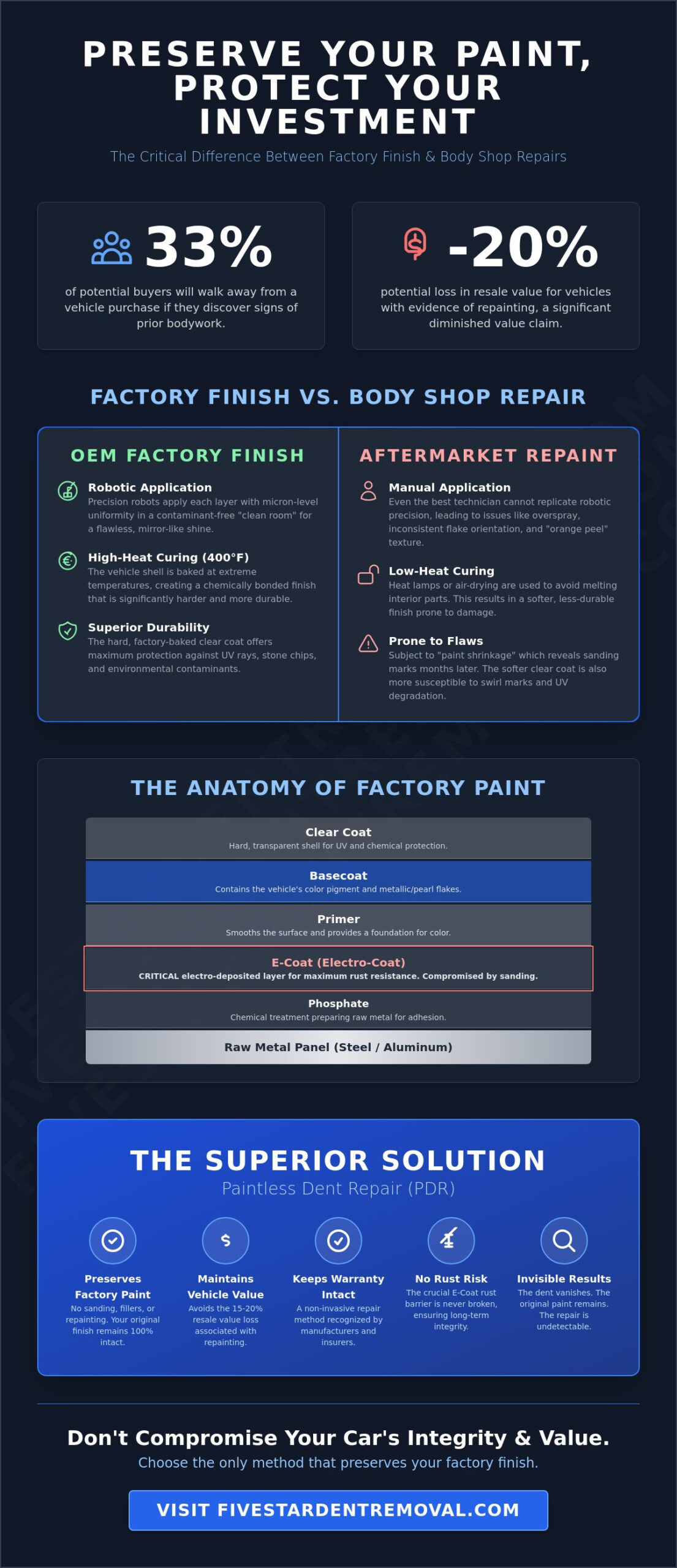
Roughly 33% of used car buyers will walk away from a purchase if they discover signs of prior bodywork. This statistic is a wake-up call for anyone looking to preserve factory paint car repair quality in 2026. You likely feel the frustration of seeing a new dent and the immediate anxiety about diminished resale value. It’s a valid concern; vehicles with evidence of repainting can sell for 15% to 20% less than those with a clean history. You deserve a solution that’s fast, cost-effective, and efficient.
This article shows why your vehicle’s original finish is a one-time industrial application that can’t be truly replicated in a standard body shop. You’ll discover how specialized techniques like Paintless Dent Repair (PDR) protect your car from future rust while keeping your factory warranty fully intact. We’ll examine the technical superiority of your original finish, the impact of new 2026 EPA regulations on automotive coatings, and why choosing the right restoration method is the only way to ensure your repair stays invisible to future buyers.
Key Takeaways
- Understand why robotic OEM application creates a precision finish that standard repair shops cannot duplicate.
- Learn how to identify “paint shrinkage” and why repainted panels often reveal hidden flaws months after the repair.
- Protect your investment by learning why you must preserve factory paint car repair quality to avoid significant diminished value claims.
- Discover the structural role of original paint as a flexible shield against rust and environmental damage.
- See why Paintless Dent Repair (PDR) is the preferred method for maintaining your vehicle’s factory warranty and structural integrity.
The Science of Factory Paint: Why It’s a One-Time Event
Factory paint isn’t a single coat of color. It’s a sophisticated, multi-layer OEM finish applied under strict industrial conditions. Understanding The Science of Factory Paint reveals why this finish is a one-time event that cannot be recreated in a local garage. Modern assembly plants use “clean room” environments to eliminate dust and airborne contaminants. High-precision robots apply each layer with micron-level uniformity. This ensures the light reflects perfectly across every panel, providing that deep, mirror-like shine found on a new showroom floor.
The original finish consists of five distinct, chemically bonded layers:
- Phosphate: A chemical treatment that prepares the raw metal surface for adhesion.
- E-coat: A vital electro-deposited layer for maximum rust resistance.
- Primer: Smooths the surface and provides a foundation for the color.
- Basecoat: The layer containing the pigment and metallic or pearl flakes.
- Clear Coat: A hard, transparent shell that protects against UV rays and environmental chemicals.
This complex stack is why specialists emphasize the need to preserve factory paint car repair quality. Once these layers are disturbed by sanding or fillers, the original factory seal is broken. The bond between these layers is forged at a molecular level that aftermarket products simply can’t match.
The 400-Degree Difference: Baking vs. Air Drying
Factory vehicle shells undergo a rigorous curing process at temperatures reaching nearly 400°F. This intense heat is only possible because the shell is baked before any plastic trim, wiring, or interior components are installed. This high-heat environment creates a chemical bond that is significantly harder and more durable than any repaint. Traditional body shops are limited by the presence of your car’s interior. They must use low-temperature heat lamps or air drying to avoid melting sensitive electronics or upholstery. These methods result in a finish that is softer and more susceptible to stone chips than the original OEM surface.
The Corrosion Barrier: Why E-Coating Matters
Rust prevention begins with the electro-deposition process, known as the E-coat. During manufacturing, the entire frame is submerged in a charged paint bath to ensure every crevice is sealed. Traditional dent repair often requires grinding through the clear coat and primer to apply body filler. This aggressive sanding frequently compromises the E-coat, leaving the underlying steel or aluminum vulnerable to oxidation from the inside out. Five Star Dent Removal avoids this risk entirely. By using specialized tools to massage the metal back into its original shape from behind, we preserve factory paint car repair integrity and keep your car’s internal rust protection fully intact.
Myth: Modern Body Shop Paint is Identical to Factory Paint
Many vehicle owners assume a high-end body shop can replicate a factory finish. This is a costly misconception. While a fresh repaint looks great on the day of pickup, it lacks the permanence of the original OEM application. Professional repaints are rarely “invisible” to the trained eye or the passage of time. Over several months, a phenomenon called “paint shrinkage” occurs. As solvents slowly evaporate from the aftermarket layers, the paint settles. This process often reveals unsightly sanding marks and substrate flaws that were hidden when you first left the shop.
Matching modern tri-coat or pearl finishes by hand is nearly impossible. Robots apply factory paint at consistent angles and pressures that ensure perfect flake orientation. A human technician, regardless of skill, cannot perfectly mirror that mechanical precision. Experts also look for “overspray” on rubber seals, trim, and door jambs. These tiny traces of paint dust are immediate red flags for inspectors and savvy buyers. If you want to avoid these issues, choosing to preserve factory paint car repair through non-invasive methods is the only logical path. This approach keeps your car’s history clean and its appearance authentic.
The Clear Coat Longevity Gap
Aftermarket clear coats are chemically different from factory versions. They’re designed to cure at lower temperatures, making them significantly softer. This softness leads to a higher rate of UV damage and “swirl marks” from standard washing. In the intense Georgia sun, these differences become obvious within just a few years. You’ll also notice “orange peel,” a bumpy texture that occurs when paint is applied outside a strictly controlled factory environment. Original paint maintains its gloss and structural integrity far longer because it was baked into a hard, resilient shell. If you have a minor ding, it’s better to trust Five Star Dent Removal for a mobile repair rather than risking a mismatched repaint.
Warranty and Insurance Implications
Repainting a panel does more than change the look; it changes your protection. Most manufacturers provide a long-term warranty against rust and perforation. Sanding down to the metal to apply filler often voids this specific coverage. Understanding How Repainting Affects Resale Value is critical for owners of high-end vehicles or leased cars. Many local Alpharetta dealers use paint depth gauges on lease returns to detect bodywork. If they find repainted panels, you could face heavy “diminished value” penalties. PDR allows you to preserve factory paint car repair standards, ensuring your factory corrosion warranty remains fully intact and your lease return goes smoothly.
Financial Impact: How Repainting Affects Resale Value in 2026
A single repainted panel can trigger a “Diminished Value” claim that costs you thousands. In the 2026 automotive market, transparency is the standard. Buyers aren’t just looking at the surface; they’re looking at the history. When you choose a traditional body shop, you’re essentially announcing that the vehicle has suffered significant trauma. This perception leads to lower offers, even if the work looks flawless. North Atlanta luxury dealers in areas like Alpharetta and Roswell now use digital paint depth gauges as a standard part of their appraisal process. These tools measure the thickness of the finish in microns. If the reading is higher than factory specifications, the dealer knows the panel was repainted. This discovery immediately devalues the vehicle, as it suggests hidden damage beneath the surface.
Paintless Dent Repair (PDR) functions as the “invisible repair.” Because no new paint is added and no sanding occurs, the micron levels remain at OEM standards. This allows you to preserve factory paint car repair quality without leaving a physical footprint. It’s the most effective way to maintain the financial integrity of your asset. By keeping the original skin intact, you ensure that even the most rigorous inspection won’t flag the vehicle for previous bodywork. You avoid the “Repaired” label that haunts traditional body shop customers during trade-ins.
Carfax and the Digital Paper Trail
Most traditional body shop repairs require an insurance claim. This process automatically triggers a “damage” entry on vehicle history reports like Carfax or AutoCheck. For owners of brands like BMW, Porsche, or Tesla, a “damage” flag can reduce the resale value by up to 20%. A clean digital history is often worth more than the cost of the repair itself. Choosing out-of-pocket PDR allows you to bypass this reporting system entirely in many cases. Since the service is mobile and non-invasive, it often stays off the digital record. You get a perfect repair while keeping your vehicle’s history report pristine.
Lease Return Standards in North Atlanta
High-end lease returns in Alpharetta are notorious for strict “wear and tear” inspections. Dealers look for any excuse to charge reconditioning fees, which are always higher than the cost of a private repair. Taking a proactive approach to fixing a dent on a car lease return saves you from these aggressive penalties. Dealerships often charge a flat fee per panel for “excessive” damage, regardless of the dent’s size. PDR is the logical choice here. It costs significantly less than the dealer’s penalty and ensures you preserve factory paint car repair standards. You return a vehicle that looks untouched, avoiding the “reconditioning” trap and protecting your wallet.
Beyond Aesthetics: The Structural Role of Factory Paint
Paint is your vehicle’s first line of defense. It functions as a flexible, protective skin for the steel or aluminum panels beneath. This engineered barrier does more than just shine. It seals the metal against oxygen and moisture, preventing the onset of oxidation. Factory paint is specifically formulated to flex with the metal during extreme temperature changes. In the Georgia heat, metal panels expand significantly. At night, they contract. The original OEM finish is designed to endure these thousands of thermal cycles without losing its bond. Repaints often lack this elasticity, leading to premature “checking” or fine cracks in the surface.
Factory sealants also play a critical role in preventing moisture intrusion at the seams and edges. When a panel is sanded for a traditional repair, these factory-applied sealants are often disturbed or removed. Repaints are notoriously more prone to stone chipping because they lack the high-heat electrochemical adhesion of the original finish. By choosing to preserve factory paint car repair standards, you maintain the structural shield that keeps your car’s body panels healthy for the long term. You aren’t just fixing a cosmetic flaw; you’re protecting the metal substrate from environmental decay.
Preserving the Metal Memory
Metal has a “memory.” When a panel is stamped at the factory, the molecules are aligned into a specific shape. Paintless Dent Repair (PDR) utilizes this property to restore the panel without harsh chemicals. The original paint’s elasticity is what makes this possible. High-quality crease dent repair requires a finish that can stretch and return to its form without cracking. Five Star Dent Removal technicians use specialized tools to massage the metal from the inside out. This methodical process respects the factory finish, ensuring the clear coat remains unbroken and the metal returns to its intended geometry.
Avoiding Body Fillers (Bondo)
Many traditional body shops don’t actually “pull” every dent. They often use a “fill and sand” method. This involves grinding away your factory paint to apply a polyester body filler, commonly known as Bondo. While it looks smooth initially, thick body filler is prone to shrinking or cracking over several years. It creates a “plug” in your panel that doesn’t expand at the same rate as the surrounding metal. PDR uses zero fillers. Your panel remains 100% metal and paint, exactly as it left the assembly line. This ensures your car remains structurally authentic and free from future material failure. To keep your vehicle in original condition, contact Five Star Dent Removal for a professional PDR evaluation today.
The PDR Solution: How to Preserve Factory Paint
Paintless Dent Repair (PDR) is the only method that truly preserves your vehicle as the manufacturer intended. It’s a specialized discipline that requires years of experience to master. Unlike traditional body shops that rely on chemical fillers and repainting, PDR focuses on the physical restoration of the metal. This is the only way to preserve factory paint car repair standards while maintaining the manufacturer’s original specifications. At Five Star Dent Removal, our process is built on three pillars: Access, Vision, and Precision.
Access involves reaching the backside of the damaged panel through factory openings, window gaps, or by removing interior trim. Vision is achieved through high-intensity LED light boards. These lights reveal the micro-shadows of the dent, allowing the technician to see exactly where the tool tip is positioned. Precision is the final, most critical stage. The technician uses hand-crafted tools to apply measured pressure, massaging the metal back to its original state. If you’ve ever wondered how does paintless dent removal work at a molecular level, the answer lies in leveraging the physical memory of modern automotive metals to reverse damage without a single drop of new paint. This technique is effective for everything from minor door dings to severe hail damage and complex creases. By choosing this path, you avoid the risks of color mismatching and paint shrinkage discussed earlier.
When to Choose PDR Over a Body Shop
Deciding between a body shop and PDR is straightforward if you know what to look for. Use this quick checklist to determine if your damage is a candidate for preservation:
- Is the paint still intact and uncracked?
- Is the metal stretched or torn?
- Was this a low-speed impact rather than a major collision?
If the paint is unbroken, PDR is almost always the superior choice. Choosing paintless dent repair in Alpharetta is faster and more affordable than traditional methods. It’s the preferred solution for high-end vehicles where maintaining the original skin is paramount. Even luxury car dent repair in Alpharetta prioritizes preservation to ensure the vehicle’s long-term value remains untouched. If you’re unsure whether your damage qualifies, our guide on what size dent can PDR fix explains exactly how technicians evaluate dent depth and metal integrity to determine candidacy.
Getting Your Free Estimate Today
Getting a professional opinion is the first step toward a perfect repair. You don’t have to wait days for a body shop quote. Most customers simply send clear photos of the damage from multiple angles to receive a rapid estimate. This process is designed for busy professionals in Buckhead, Roswell, and Alpharetta who value their time. We offer mobile dent repair services that come to your home or office, providing a level of convenience that traditional shops can’t match. You get a high-quality, invisible repair without the hassle of a rental car or a week-long wait. To preserve factory paint car repair quality and protect your investment, Contact Five Star Dent Removal today for your free local estimate.
Protect Your Investment with Professional PDR
Your vehicle’s original finish is more than just a color choice; it’s a high-performance protective barrier that cannot be duplicated once lost. Choosing to preserve factory paint car repair quality ensures your car remains structurally sound and financially valuable in the 2026 market. Traditional repaints often lead to paint shrinkage and diminished value. By opting for Paintless Dent Repair, you keep your vehicle’s history clean and its factory warranty fully intact.
Five Star Dent Removal brings over 20 years of PDR expertise to every project. We specialize in high-end and luxury vehicle preservation for owners who demand perfection. Our team provides mobile and shop-based service throughout North Atlanta, ensuring convenience without compromising on quality. Don’t let a minor dent become a permanent mark on your vehicle’s history or a drain on its resale value.
Get a Free Estimate to Save Your Factory Paint and restore your car’s showroom appearance today. You can feel confident that your vehicle is in the hands of seasoned specialists who value precision as much as you do.
Frequently Asked Questions
Will paintless dent repair cause my factory paint to crack?
Paintless dent repair will not cause your finish to crack because factory-applied paint is engineered with significant elasticity. It’s designed to flex alongside the metal panels during thermal expansion and contraction. Our technicians use specialized tools to massage the metal gradually, ensuring the stress on the clear coat remains well within its physical limits. This process maintains the integrity of the original finish without compromising the bond between the paint layers.
How can I tell if my car has its original factory paint?
You can identify original paint by inspecting for “overspray” on rubber seals or inconsistent textures known as “orange peel.” Professional inspectors often use digital paint depth gauges to measure thickness in microns. Factory finishes typically show a very consistent, thin measurement across all panels. If one panel reads significantly thicker than the others, it indicates that the area has likely been repainted at a traditional body shop.
Does PDR show up on a Carfax report?
Paintless dent repair typically does not appear on a Carfax report when the service is handled as a private, out-of-pocket transaction. Traditional body shop repairs often require insurance involvement, which triggers an automatic digital damage flag. By choosing PDR, you often avoid this reporting process entirely. This helps you preserve factory paint car repair records and maintain a clean history for future buyers in the competitive North Atlanta market.
Can PDR fix dents on a body line without damaging the paint?
Specialized PDR techniques can successfully restore sharp body lines without harming the finish. These areas are structurally reinforced, requiring higher technical skill and specific leverage points. Our specialists use high-strength steel tools to rebuild the line’s geometry from behind the panel. This methodical process respects the original paint’s bond while restoring the vehicle’s aesthetic profile to factory standards without the need for fillers.
Why do body shops want to repaint the whole panel for a small dent?
Body shops repaint entire panels to ensure the new color “blends” with the surrounding areas. Because aftermarket paint is mixed by hand, it rarely matches the factory-applied pigment perfectly. Repainting the whole panel hides these slight color variances from the naked eye. This aggressive approach is often unnecessary for minor damage that can be resolved through PDR, which leaves your original finish untouched and avoids color matching issues. Before assuming a full repaint is necessary, it’s worth understanding what size dent can PDR fix, since many dents that appear too large for paintless repair are actually strong candidates for this non-invasive method.
Is factory paint really harder than body shop paint?
Factory paint is significantly harder and more durable than aftermarket alternatives due to the industrial high-heat curing process. Assembly plants bake empty vehicle shells at nearly 400°F to create a superior chemical bond. Body shops cannot use these temperatures because they would melt the car’s interior, electronics, and plastic trim. This results in a softer finish that is more prone to rock chips and environmental wear compared to the OEM surface.
What happens if the paint is already chipped inside the dent?
PDR can still restore the metal’s shape even if the surface is chipped, but it won’t repair the missing paint. In these cases, we focus on removing the dent to restore the panel’s original geometry first. You can then apply a high-quality touch-up paint to seal the chip. This combined approach is still more effective for your resale value than repainting the entire panel and losing the original, more durable OEM finish.