

Your vehicle’s factory finish is its most valuable asset, yet traditional body shops often destroy it just to fix a minor dent. Understanding how does paintless dent removal work reveals that PDR isn’t a cosmetic trick. It is a surgical restoration process that leverages the physical properties of modern automotive metals to reverse damage at the molecular level. There’s no need for sanding, fillers, or non-factory paint when the metal itself can be massaged back to its original form.
If you’re worried about ruining your original paint or facing high lease return fees, you’re not alone. Most drivers feel that same anxiety when they see a fresh door ding. We will show you the precision engineering and specialized techniques, including the use of advanced tools like the DYPDR Light 100 Ultra, that restore your car’s exterior without a single drop of new paint. This guide breaks down the mechanical process of PDR, explains how it preserves vehicle resale value, and helps you determine if your specific dent is a candidate for professional repair.
Key Takeaways
- Learn why PDR is the preferred non-invasive solution for erasing dings and hail damage without the need for body fillers or repainting.
- Discover the physics behind metal memory and how does paintless dent removal work to return aluminum and high-strength steel to their factory form.
- Realize the massive advantage of preserving your original paint finish, which is baked at temperatures higher than any local shop can match.
- Quickly determine if your vehicle is eligible for repair based on the condition of the paint film and the placement of the damage.
What is Paintless Dent Repair (PDR)?
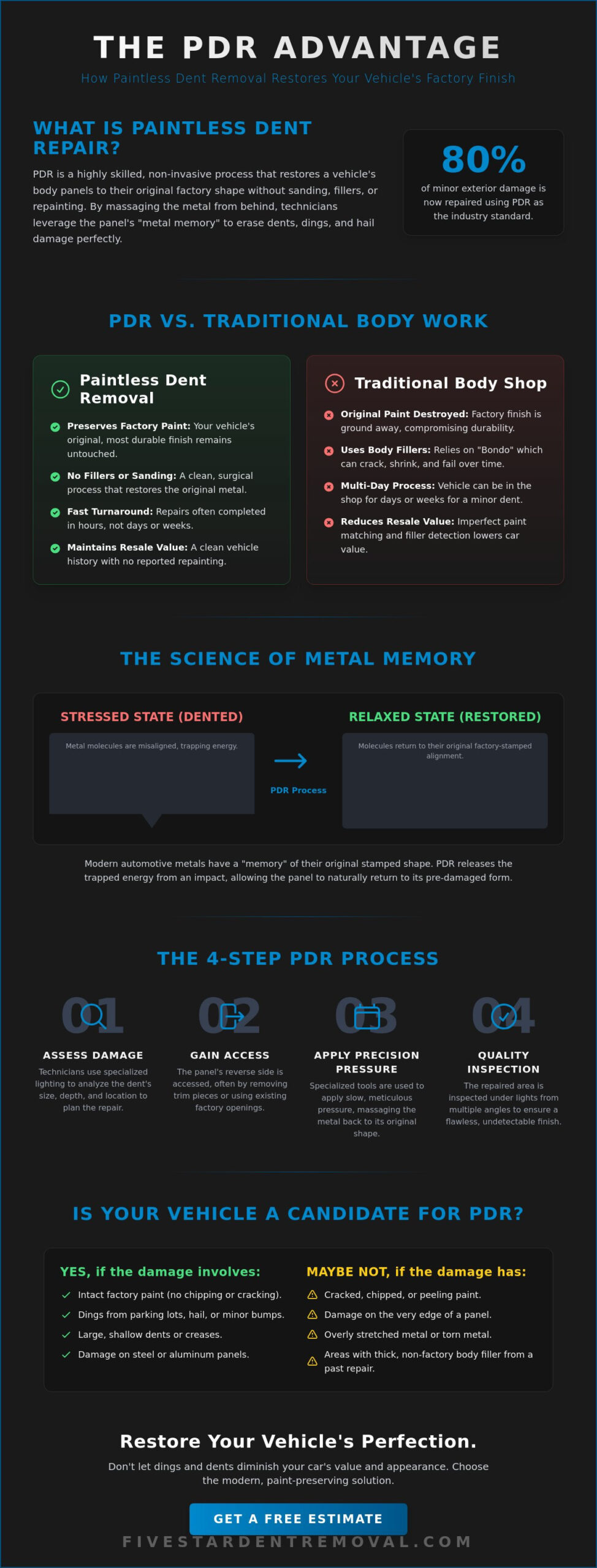
What is Paintless Dent Repair (PDR)? It is a specialized method of removing dings, dents, and hail damage without compromising the vehicle’s original finish. It’s a clean, efficient process. No body fillers are used. No sanding is required. Most importantly, no new paint is ever applied to the panel. By 2026, PDR has become the definitive industry standard, now serving as the primary solution for 80% of minor exterior vehicle damage. It’s no longer just a niche service; it’s the first line of defense for modern automotive care.
Insurance companies frequently mandate PDR as the preferred repair method following Georgia hail storms because it’s faster and more reliable. When people ask how does paintless dent removal work, they’re often surprised to learn it’s about precision pressure rather than chemicals or heat. We focus on the structural integrity of the metal itself. This keeps the repair permanent and the vehicle’s value high. It’s a pragmatic approach for drivers who value quality but don’t want their car sitting in a shop for weeks.
The Core Difference: PDR vs. Traditional Body Work
Traditional body shops often perform what we consider “open heart surgery” on your car. They grind down the paint, drill holes, and apply heavy “Bondo” fillers. Then, they attempt to match a new paint layer to your aged factory finish. It’s an invasive, multi-day process. PDR is the non-invasive alternative. We use the original metal and specialized tools to massage the dent out from the inside. This approach keeps your factory paint warranty intact. You keep the finish that was baked on at the factory. This ensures long-term durability that a local respray simply can’t match. For a detailed breakdown of when each approach makes sense, our PDR vs traditional body repair 2026 guide walks through the technical suitability of both methods. It’s a faster, smarter way to handle repairs.
Common Types of Damage PDR Can Fix
PDR is exceptionally effective for various types of daily wear and environmental damage. Understanding how does paintless dent removal work helps you see why it’s the best fit for common scenarios. We regularly handle:
- Standard door dings acquired in busy Alpharetta shopping center parking lots.
- Complex hail damage patterns that frequently impact drivers across North Atlanta during storm season.
- Large, shallow dents or sharp creases where the paint hasn’t cracked.
If the paint isn’t chipped or peeling, there’s a high probability that PDR can restore the panel to its original state. As long as the metal hasn’t been stretched beyond its elastic limit, our technicians can reverse the damage completely. It’s about restoring the car, not just covering up the problem.
The Science of Metal Memory and Molecular Structure
Most car owners view a dent as a permanent deformation of their vehicle’s body. In reality, modern automotive panels are designed with a specific “memory.” During the factory manufacturing process, metal sheets are stamped into shape under immense pressure. This process creates specific molecular bonds that define the panel’s permanent state. When a dent occurs, it doesn’t just change the shape; it creates trapped energy within the metal’s grain structure. Understanding how does paintless dent removal work starts with recognizing that the metal actually wants to return to its original configuration.
Modern vehicles utilize high-strength steel and aluminum alloys engineered for high elasticity. These materials can withstand significant flex before the molecular structure is permanently compromised. Technicians use this elasticity to their advantage. By identifying the crown or the “pressure point” of a dent, we can determine where the metal is under the most stress. Professional technicians read these stress points by observing how light reflects off the surface, ensuring they don’t over-stretch the panel during the repair. If you are unsure if your damage is too severe, checking if Is Your Vehicle a Candidate for PDR? is a great first step before seeking a repair.
Metallurgy 101: Why Your Car “Remembers” Its Shape
The stamping process at the factory aligns the metal’s molecules into a “relaxed” state. A dent represents a “stressed” state where energy is locked into the grain of the metal. If the impact didn’t stretch the metal beyond its elastic limit, that original molecular map remains intact. PDR technicians simply release this trapped energy. By applying calculated pressure to the backside of the dent, we allow the molecular bonds to pull the metal back into its factory-stamped form. It’s a pragmatic application of physics that preserves the car’s structural integrity.
The Role of Specialized PDR Tooling
Precision requires more than just force; it requires the right leverage. Technicians use an array of specialized tools to access the tightest areas of a vehicle. These aren’t standard hardware store items. They are high-grade instruments designed for specific movements.
- Stainless Steel Rods: These come in various lengths and diameters, featuring interchangeable tips ranging from blunt plastic to surgical steel points for micro-adjustments.
- Whale Tails: These flat, wide tools are designed to slide behind door braces and roof rails where space is measured in millimeters.
- Glue Pulling Systems: When a panel is double-walled or lacks a rear access point, we use specialized tabs and high-strength adhesive to pull the dent from the exterior.
Temperature also plays a vital role in the process. We often use controlled heat to make the metal and paint more pliable, which prevents the finish from cracking during the massage process. This methodical approach ensures a perfect finish every time. If you’ve discovered a fresh ding on your door, Five Star Dent Removal can use these scientific methods to restore your vehicle’s exterior to its original condition.
The Step-by-Step PDR Process: From Assessment to Finish
Professional PDR is a disciplined sequence of events. It begins with a meticulous damage assessment. Technicians examine the paint film to ensure it remains bonded to the substrate. If the finish is compromised, traditional methods might be required. Once cleared, we move to gaining access. This involves navigating through window channels, removing interior trim panels, or using factory-drilled access points to reach the backside of the metal. There is no guesswork. Every move is calculated to preserve the vehicle’s structural integrity.
The core of how does paintless dent removal work lies in the technician’s ability to see what the naked eye misses. We use specialized LED boards to project straight lines across the damaged area. Any distortion in these lines reveals the exact depth and perimeter of the dent. This creates a topographical map of the damage. Once the map is set, the technician begins the “massage.” This involves thousands of tiny, precise pushes from behind the panel. The process concludes with final blending, where we ensure the “orange peel” texture of the repair area perfectly matches the rest of the car.
Lighting: The Technician’s Secret Weapon
Lighting is the most critical tool in a specialist’s arsenal. Professional LED reflection boards cast a series of parallel lines or a soft “fog” onto the car’s surface. By watching how these lines bend, the technician can pinpoint the exact tip of their tool behind the metal. This precision relies heavily on understanding , which dictates how the panel reacts to pressure. Most professional PDR lights in 2026 now feature adjustable color temperatures. This allows us to adjust the light to contrast against different paint colors, such as metallic silver or deep black, ensuring every micro-adjustment is visible.
The “Massage” Technique Explained
A common misconception is that a dent simply “pops” back into place. In reality, a quality repair requires patience and extreme hand-eye coordination. We use various stainless steel rods to apply microscopic pressure. If the metal is pushed too far, “knockdown” tools are used to gently tap down high spots from the exterior. This constant back-and-forth movement is especially vital for crease dent repair, where the metal has been folded rather than just dented. We move the metal in small increments to prevent the paint from stretching or cracking. This methodical approach ensures the repair is permanent and invisible to even the most trained eye.
Why PDR is Essential for Preserving Factory Paint
Your car’s factory paint is a one-time event. During manufacturing, bare metal shells are baked at temperatures exceeding 400 degrees Fahrenheit. This extreme heat creates a finish that is incredibly hard, durable, and resistant to environmental hazards. Once a vehicle is fully assembled, it can never be subjected to those temperatures again. Interior plastics, rubber seals, and sensitive electronics would simply melt. This is why understanding how does paintless dent removal work is critical. PDR is the only method that keeps this superior factory bond completely intact.
Traditional body shops rely on air-dried or low-heat cured paints. These aftermarket finishes never achieve the same hardness as the original coat. This leads to several long-term issues. Silver and pearl paints are notorious for being nearly impossible to match perfectly. Even a master painter struggles to align metallic flakes exactly as a factory robot does. Furthermore, the body fillers used in traditional repairs often shrink or crack over years of thermal expansion and contraction. When you choose to preserve factory paint car repair, you avoid these cosmetic and structural risks entirely.
Resale Value and the Carfax Factor
Conventional body work is often a red flag for future buyers. Repairs involving sanding and painting are frequently flagged in vehicle history reports. This can lead to significant “diminished value” claims. PDR is a “silent” repair. It doesn’t trigger structural damage warnings because the original panels and paint remain untouched. This is a vital consideration for luxury car dent repair Alpharetta owners. Maintaining a pristine Carfax report is essential for protecting the high-end resale value of premium vehicles. Precision PDR ensures the repair is invisible to both the naked eye and the history report.
The Environmental Impact of Paintless Methods
PDR is the “greenest” choice for automotive restoration in 2026. Traditional repair methods generate significant chemical waste. They require toxic primers, basecoats, and clearcoats that release Volatile Organic Compounds (VOCs) into the atmosphere. The PDR process produces zero VOC emissions. There is no paint runoff or hazardous material disposal required. It is a clean, mechanical process that achieves better results with a fraction of the environmental footprint. It is the most sustainable way to keep your vehicle looking showroom-new.
Don’t settle for invasive repairs that compromise your car’s original finish. Protect your investment with a specialized, non-invasive approach. If you have a dent that needs expert attention, contact Five Star Dent Removal for a professional assessment and keep your factory paint perfect.
Is Your Vehicle a Candidate for PDR?
Identifying if your car is a candidate for PDR requires a quick visual inspection. Start with the paint film. If it is cracked, chipped, or peeling, PDR cannot fix the underlying damage. Traditional methods are required once the paint’s integrity is lost. Next, check the location. Dents on the extreme edges of panels are difficult because the metal is often reinforced or folded there. Finally, look at the depth. Extremely sharp, “pointed” dents may have stretched the metal past its elastic limit. Understanding how does paintless dent removal work helps you recognize that if the metal is physically torn or over-extended, the “memory” we rely on is gone. If you’re unsure whether the size or severity of your damage qualifies, our detailed breakdown of what size dent can PDR fix explains exactly when professional PDR is the right call versus traditional body work.
Efficiency is the hallmark of modern repair. For busy professionals, mobile dent repair Alpharetta offers a seamless way to handle maintenance. We provide the same level of precision found in a shop but at your location. This eliminates the frustration of coordinating rides or losing your vehicle for a week. It’s a direct, no-nonsense approach to automotive care that values your time as much as your car’s appearance.
The Lease Return and Trade-In Strategy
Lease return inspections in North Atlanta are notoriously strict. A single door ding can result in a penalty that far exceeds the cost of a professional repair. Dealerships prioritize “Certified Pre-Owned” status for their inventory, and they rely on PDR to achieve that standard. By handling the repair yourself before the turn-in date, you keep more money in your pocket. Alpharetta residents heading to local dealerships for a trade-in should view PDR as a strategic move to maximize their vehicle’s valuation. It is a small investment that prevents thousands in lost trade-in value.
Next Steps: Getting an Accurate PDR Estimate
Getting an accurate quote is a straightforward process. While digital photos give us a baseline, a physical inspection is essential for a definitive price. A technician must observe the “shadows” in the metal under professional lighting to map the work accurately. Most cost of paintless dent repair assessments are completed in minutes. Our process is transparent and designed to give you an immediate solution. Ready to see the “magic” of science in action? Get a free quote from Five Star Dent Removal and experience the reliability of expert craftsmanship.
Protect Your Investment with Scientific Precision
Choosing the right repair method is about more than just fixing a dent; it is about protecting the long-term integrity of your vehicle. You have seen how the combination of metal memory and specialized lighting allows for a restoration that traditional body shops cannot replicate. Now that you understand how does paintless dent removal work, you can make an informed decision that saves your factory paint and preserves your car’s resale value. It is the most efficient and environmentally friendly way to handle exterior damage.
Five Star Dent Removal brings over 20 years of professional PDR experience to every job. We specialize in luxury and high-end vehicle restoration, ensuring your car receives the expert care it deserves. Our mobile service is available throughout North Atlanta, providing convenience without sacrificing quality. Don’t let a minor ding diminish your car’s beauty or value. Restore your vehicle’s factory finish with Five Star Dent Removal today. Your car will look as though the damage never happened.
Frequently Asked Questions
Can PDR fix a dent if the paint is scratched?
PDR can successfully restore the metal’s shape, but it won’t remove the scratch itself. If the paint film is physically broken or missing, the indentation can still be leveled to a factory-flat state. Many North Atlanta drivers choose this route to avoid heavy body fillers, followed by a simple touch-up to protect the exposed area from corrosion.
How long does the average paintless dent removal take?
Minor door dings and small creases are typically repaired in 60 to 90 minutes. Larger damage or complex hail repair patterns may require a few hours of focused work. This speed is a primary benefit for busy professionals who cannot afford to leave their vehicle at a traditional body shop for several days.
Will the dent come back after it has been fixed with PDR?
No, the repair is permanent. Once the technician releases the trapped energy and returns the metal to its original molecular map, it stays there. The panel will not “pop” back into a dented state because the structural tension has been neutralized. It is a permanent restoration of the factory form.
Is PDR covered by my auto insurance policy?
Yes, most insurance carriers recognize and prefer PDR for hail damage and minor exterior repairs. Because the process is often more cost-effective than traditional body work, the total cost might be lower than your deductible for a single ding. It’s best to verify your specific coverage limits before starting a claim.
Can PDR be done on aluminum body panels like those on a Tesla or Ford F-150?
Yes, we perform PDR on aluminum panels regularly. Aluminum is less elastic than steel and requires a more methodical approach with specialized tools. Technicians must understand how does paintless dent removal work differently on these alloys to prevent the metal from becoming brittle or “work-hardened” during the massage process.
What happens if a technician over-stretches the metal?
Over-stretching creates “high spots” or small protrusions in the panel. If a technician lacks precision, they can push the metal too far and potentially crack the factory clearcoat. Expert specialists avoid this by using “knockdown” tools and high-resolution LED lighting to monitor every microscopic movement of the metal grain.
Can I do paintless dent repair myself with a kit from the internet?
DIY kits carry a high risk of causing permanent damage to your vehicle’s finish. Without professional training and LED reflection boards, it is nearly impossible to see the exact tip of the tool behind the metal. Most amateur attempts result in over-stretched metal or cracked paint that requires an expensive traditional body shop repair vs PDR to fix.
Does PDR work on plastic bumpers?
Yes, we offer specialized bumper repair for plastic components that have been indented. While the molecular structure of plastic differs from metal, we use controlled heat to make the material pliable and massage it back to its original contour. If the paint hasn’t been scraped off during the impact, the results are often flawless.