

The most expensive part of a car repair isn’t always the bill; it’s the permanent loss of your vehicle’s factory finish. While a traditional body shop is the standard response to a dent, repainting a panel often triggers a diminished value report that hurts you at resale. When comparing PDR vs traditional body repair, the superior engineering choice is often the one that leaves the original paint untouched. You shouldn’t have to choose between a flawless exterior and your car’s long-term market value.
We know the frustration of staring at fresh damage while worrying about high insurance deductibles or being stranded without a ride for weeks. You need a solution that fits a busy schedule without compromising on quality. This 2026 guide explains how specialized techniques can restore your car in hours rather than days. We’ll examine the technical suitability of each method, the impact on your vehicle history, and why preserving your factory seal is the smartest financial move you can make. Our goal is to get you back on the road with a perfect finish and your equity intact.
Key Takeaways
- Learn why non-invasive metal restoration is the engineering standard for preserving your vehicle’s factory integrity.
- Use our suitability checklist to determine if your damage requires a traditional shop or if it qualifies for a faster, paint-free fix.
- Compare the timelines and financial impacts of PDR vs traditional body repair to see how specialized techniques save you days of downtime.
- Protect your vehicle’s resale value and avoid expensive lease return penalties by maintaining the original paint seal.
- Discover the specific scenarios where traditional bodywork is necessary, such as structural frame damage or compromised paint.
PDR vs Traditional Body Repair: Understanding the Core Methodologies
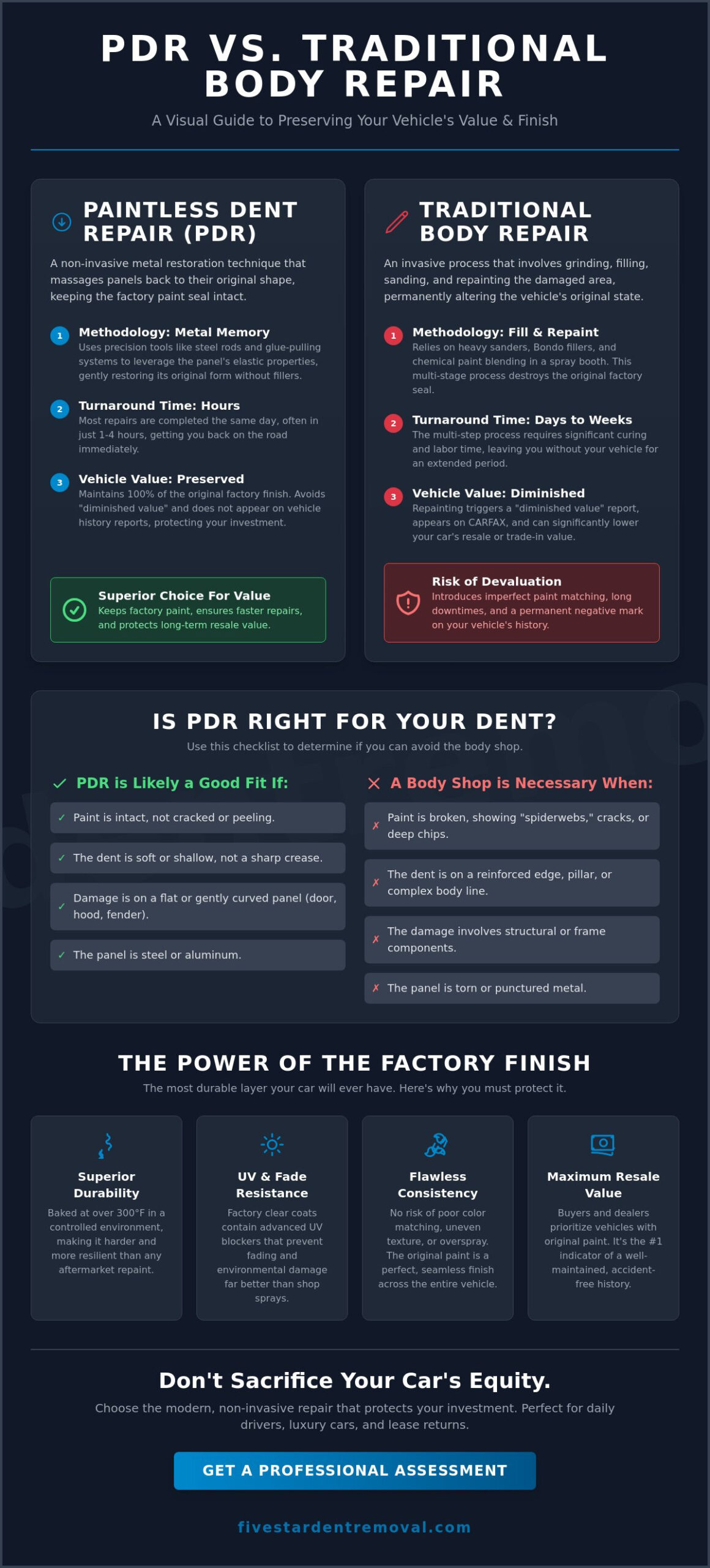
The choice between PDR vs traditional body repair comes down to how you treat the metal and the paint. Paintless Dent Repair (PDR) is a specialized, non-invasive metal restoration process. It focuses on returning the panel to its original shape without disturbing the exterior finish. Traditional body repair takes an invasive route. It involves grinding down the paint, applying Bondo fillers, and using chemical paint blending to hide the damage. Understanding the mechanics of PDR vs traditional body repair helps you make a better financial decision for your vehicle.
The tools define the results. PDR technicians utilize high-grade steel rods and precision glue-pulling systems to manipulate the metal from behind. In contrast, a traditional shop relies on heavy sanders, fillers, and industrial spray booths. The primary goal of PDR is to keep the factory seal intact. This seal is the most durable layer your car will ever have. It’s applied in a controlled factory environment where the paint is baked at temperatures often exceeding 300 degrees Fahrenheit. A local spray booth cannot replicate this environment without damaging your car’s interior and electronics, making the original finish superior in hardness and UV resistance.
The Science of Metal Memory
Every vehicle panel has elastic properties. Technicians use these properties to “massage” the metal back into its original form using controlled pressure. This process leverages the science of professional PDR to ensure the structural integrity remains sound. Traditional shops often skip this delicate work. They frequently choose to replace entire panels or use thick fillers because it requires less technical finesse than true metal shaping. By avoiding replacements, you keep the original parts that were fitted to your car’s frame at the factory.
Traditional Body Shop Workflow: Why It Takes So Long
A traditional repair is a multi-stage marathon. It begins with stripping the original paint. Technicians then apply body filler, wait for it to cure, and sand it smooth. Priming, painting, and clear-coating follow. Even with modern technology, paint matching is rarely 100% perfect. Factors like UV fading and paint batch variations make a total match difficult. Beyond the aesthetics, these repairs often appear on vehicle history reports. A reported accident or repaint can drop your car’s resale value significantly compared to a vehicle that retains its original factory panels and finish.
The PDR Suitability Checklist: What Dents Can Be Fixed with PDR?
Determining whether your vehicle is a candidate for Paintless Dent Repair (PDR) requires a quick visual assessment. Not every dent is the same. When evaluating PDR vs traditional body repair, you must look at the condition of the paint and the location of the impact. While many believe PDR is only for small door dings, modern tools allow specialists to tackle significant damage that previously required a full body shop visit. Use this checklist to see where your damage falls:
- Paint condition: Is the finish smooth or is the paint cracked and peeling?
- Depth and sharpness: Is it a soft, shallow ding or a sharp, deep crease?
- Location: Is the dent in the center of a panel or on a reinforced edge or pillar?
- Metal type: Is the panel made of traditional steel or modern aluminum?
Professional technicians can often handle PDR for large dents that might appear beyond repair at first glance. If you’re unsure if your damage qualifies, request a professional assessment to see if you can avoid the body shop entirely.
The Paint Integrity Test
The most critical factor in the PDR vs traditional body repair decision is the paint’s surface. Inspect the area for “spiderweb” cracks or tiny chips. If the paint is broken, traditional repair is necessary to prevent rust. However, don’t mistake paint transfer for a scratch. Often, the white or yellow marks from another car’s door are just surface residue that polishes off during the PDR process. Remember that preserving factory paint is your best defense against diminished resale value. Once you repaint a panel, you lose that original factory seal forever.
Complex Dents: Creases and Body Lines
There is a common myth that PDR cannot fix dents located on body lines or sharp creases. This is outdated information. Advanced glue-pulling techniques and specialized lighting allow technicians to reshape metal even on these rigid structural points. The “Rule of Thumb” is simple: if the paint is 100% intact and the metal hasn’t been stretched to the point of tearing, PDR is likely possible. Even large-scale panel deformation can often be massaged back to its original shape without the need for Bondo or fillers. This preserves the structural integrity of the panel while keeping your vehicle’s history report clean.
Analyzing the Real-World Costs and Turnaround Times
Efficiency drives the financial logic behind the PDR vs traditional body repair debate. Traditional body shops carry massive overhead in the form of specialized paints, chemical fillers, and industrial energy costs for spray booths. These expenses are passed directly to you. Paintless Dent Repair eliminates these material costs entirely. Because the process relies on technical skill and specialized hand tools rather than consumable supplies, the price reflects the labor rather than a list of expensive parts and chemicals. This streamlined approach makes it a pragmatic choice for anyone looking to restore their vehicle without unnecessary markups.
Time is your most valuable asset. A traditional body shop often requires you to leave your vehicle for several days or even weeks. This delay stems from the multi-stage nature of painting; each layer of primer, base coat, and clear coat requires specific curing times. Additionally, current industry trends show that body shops often face backlogs due to parts shortages and insurance processing delays. PDR bypasses these hurdles. Most repairs are completed in a matter of hours, allowing you to maintain your daily routine without the logistical headache of a long-term service appointment.
PDR vs. Traditional Cost Framework
Financial strategy is key when dealing with minor damage. Many vehicle owners find that PDR costs actually fall below their standard insurance deductible. Paying out-of-pocket for a specialized repair is often cheaper than the long-term premium hikes associated with filing a claim. Furthermore, choosing PDR provides a higher return on investment for trade-ins. A car with its original factory paint is worth significantly more to a dealership than one with a reported accident and a resprayed panel. You save money today while protecting your equity for tomorrow.
The Convenience Factor: Mobile vs. Shop
For busy Alpharetta professionals and families across North Atlanta, logistics are often the biggest barrier to repair. Traditional shops require you to drop off the car and arrange for a rental, adding another layer of expense and frustration. Five Star’s mobile dent repair model brings the expertise directly to your home or office. This “while-you-work” service ensures your vehicle is restored while it sits in your driveway or parking deck. We focus on getting you back on the road with zero downtime, providing a level of efficiency that traditional brick-and-mortar shops simply cannot match.
- No Rental Costs: Avoid the $50 to $100 daily fee for a substitute vehicle.
- Zero Diminished Value: Keep your vehicle history clean and avoid the “reported accident” tag.
- Rapid Completion: Most dings and minor dents are resolved in a single afternoon.
Why PDR is the Superior Choice for Luxury Cars and Lease Returns
High-end vehicles demand a higher standard of care. For owners of brands like Tesla, BMW, or Porsche in the Alpharetta area, maintaining “original” status is the single most important factor for long-term value. When you weigh PDR vs traditional body repair for a luxury asset, the non-invasive route is almost always the correct engineering choice. Traditional shops often rely on sanding and repainting, which can be detected by professional buyers using paint depth gauges. This immediately flags the car as having “prior paintwork,” often reducing its trade-in value by thousands of dollars regardless of the repair quality.
Specialized finishes require specialized solutions. Many modern luxury cars feature complex tri-coat pearls or matte finishes that are notoriously difficult to match in a local spray booth. Because Paintless Dent Repair leaves the factory finish untouched, there’s zero risk of color mismatch or texture variations. It’s the preferred method for luxury car dent repair because it respects the precision engineering of the vehicle’s exterior. Choosing Five Star ensures your car remains 100% original, preserving both its aesthetic beauty and its market equity.
The Lease Return Strategy
Lease return inspections are notoriously strict. Most manufacturers follow a “credit card size” rule; any damage larger than a standard card is classified as “excessive wear and tear.” Returning a car with these dings can result in penalties ranging from $500 to $2,000 per panel. PDR is a “stealth” repair. Since no fillers or aftermarket paints are used, the repair is invisible to inspectors and won’t show up on vehicle history reports. A small proactive investment in mobile dent repair before your inspection date can save you a significant amount in end-of-lease fees.
Luxury Paint Systems and PDR
Precision is mandatory for North Atlanta’s high-end automotive standards. Traditional repainting on luxury vehicles often leads to “halos” or visible blending lines where the new paint meets the old. This is particularly problematic on the aluminum panels used by Tesla and Audi, which dissipate heat differently than steel during the curing process. Our technicians understand these paint sensitivities. We use controlled, methodical pressure to restore the metal without stressing the clear coat. It’s a clean, efficient, and sophisticated process that aligns with the quality of the car you drive. Before you commit to a body shop, schedule your luxury vehicle assessment to see if PDR is the right fit for your car.
- Maintain OEM Status: Keep every panel and paint layer original.
- Avoid Lease Penalties: Fix dings for a fraction of the manufacturer’s “excessive wear” charges.
- Invisible Restoration: No paint depth changes that alert future buyers to repairs.
Choosing Your Path: When to Visit a Body Shop vs. Calling Five Star
Deciding between PDR vs traditional body repair requires a clear evaluation of your goals. If your priority is speed, cost-efficiency, and resale value, PDR is the logical starting point. The severity of the impact often dictates the path. We use a three-point matrix focusing on intent, budget, and damage severity to guide our customers. If the paint is intact and the metal hasn’t been overstretched, a specialized restoration is almost always possible. Always seek a professional PDR assessment before committing to a body shop. It’s the most effective way to avoid unnecessary repainting and the permanent loss of your factory finish.
Efficiency and transparency define our approach. We understand that vehicle damage is a major frustration. Our goal is to provide immediate relief through expert resolution. By choosing the right method for PDR vs traditional body repair, you ensure your vehicle receives the precise care it needs without hidden costs or long-term value loss. We prioritize high-quality results that respect both your schedule and your financial sensibility.
When to Go Traditional
While we specialize in non-invasive fixes, some damage requires a heavy-duty approach. Traditional body work is unavoidable when there is structural compromise. If your vehicle requires a frame machine to align the chassis, a certified collision center is necessary. Other indicators include significant paint loss where metal is exposed or damage that spans across multiple complex structural pillars. In these cases, the grinding, filling, and chemical blending processes of a traditional shop are required to ensure the vehicle is safe and aesthetically sound. We prioritize your safety and will always be transparent if a dent exceeds the technical limits of PDR.
Why Five Star Dent Removal is the Alpharetta Standard
We’ve built our reputation as a reliable regional specialist by focusing on precision and quality. Our process is designed for the modern driver who values their time and their vehicle’s equity. We provide high-impact results through a mobile service model that covers Roswell, Sandy Springs, and Buckhead. This allows us to perform expert repairs at your location, removing the friction of car rentals and long shop backlogs. We act as your dependable neighbor with advanced technical skills, ensuring every repair meets the Five Star standard of excellence. Our commitment to honesty and efficiency is what separates us from less established competitors.
Getting an expert verdict is simple and fast. For a no-obligation look at your damage, text a clear photo of the dent to our specialists. We can quickly determine if you qualify for paintless dent repair in Alpharetta or if a body shop is required. This proactive step saves you hours of research and helps you choose the most financially sensible path for your vehicle. Our solution-oriented approach ensures you get the right fix the first time.
Restore Your Vehicle’s Value with Expert Precision
Choosing the right restoration method is about more than just fixing a dent; it’s about protecting your vehicle’s long-term equity. Maintaining original factory paint is the most effective way to avoid diminished value reports and expensive lease return penalties. While the debate of PDR vs traditional body repair often focuses on immediate costs, the real winner is the method that preserves the structural and aesthetic integrity of your car. By prioritizing non-invasive techniques, you save days of downtime and keep your vehicle history clean.
Five Star brings over 20 years of professional industry experience directly to your home or office. We specialize in luxury car and lease return restoration, ensuring your high-end vehicle meets the strictest standards. Our mobile service operates throughout North Atlanta, providing the convenience you need for a busy schedule. Don’t let a minor dent become a permanent financial burden on your car’s resale price. Save your factory paint—get a free PDR estimate today! We look forward to restoring your vehicle to its original, flawless condition.
Frequently Asked Questions
Is Paintless Dent Repair as permanent as a traditional body shop fix?
Yes, PDR is a permanent structural restoration of the metal. Once a technician massages the panel back to its original form, the repair will never fail or change shape. Traditional repairs rely on bondo or fillers that can eventually shrink, sink, or crack; PDR returns the metal to its factory state without adding unstable materials.
Will PDR show up on my car’s Carfax or vehicle history report?
PDR typically does not appear on vehicle history reports like Carfax. Because the process is non-invasive and doesn’t require panel replacement or repainting at a collision center, it remains a stealth repair. This is a significant factor when weighing PDR vs traditional body repair, as it helps you maintain a clean vehicle history and higher resale value.
Can PDR fix a dent if the paint is scratched but not missing?
We can often repair the dent even if there is surface scratching. If the paint hasn’t cracked, flaked, or been removed down to the primer, the metal can still be safely restored. Any light surface scratches or paint transfer from another vehicle can usually be polished out after the dent is removed, leaving a flawless finish.
How much does a typical PDR repair cost compared to a body shop?
PDR is significantly more cost-effective, often saving you 40% to 70% compared to traditional body shop rates. These savings come from the total elimination of material overhead like paint, sandpaper, and chemical fillers. By choosing specialized restoration, you pay for technical expertise rather than a long list of consumable shop supplies and environmental fees.
What happens if I try to fix a dent myself before calling a pro?
DIY attempts often cause irreversible damage to the paint and metal. Suction cup kits or heat hacks can overstretch the metal or cause the factory clear coat to crack. Once the metal is oil-canned or the paint is compromised by a DIY mistake, a simple PDR fix often turns into a mandatory and expensive body shop repainting job.
Does insurance cover Paintless Dent Repair for hail damage?
Yes, PDR is the preferred method for insurance companies handling hail damage claims. Most comprehensive policies cover these repairs because they are faster and preserve the vehicle’s original value better than traditional methods. In many cases, the total cost for PDR falls below your deductible, making out-of-pocket payment a smarter long-term financial move.
Can PDR be used on aluminum panels found on newer luxury cars?
Professional technicians can successfully repair aluminum panels using specialized tools and heat-assisted techniques. Aluminum is more rigid than steel and has less memory, which makes it more difficult to manipulate. However, our specialists have the advanced training required to restore aluminum components on high-end brands without damaging the structural integrity of the panel.
How long do I have to wait to drive my car after a PDR service?
You can drive your vehicle immediately after the technician finishes the repair. There is no waiting period because the process involves no paints to dry, no fillers to cure, and no chemical odors to dissipate. This immediate turnaround is a primary benefit of PDR vs traditional body repair, allowing you to return to your busy schedule without any downtime.